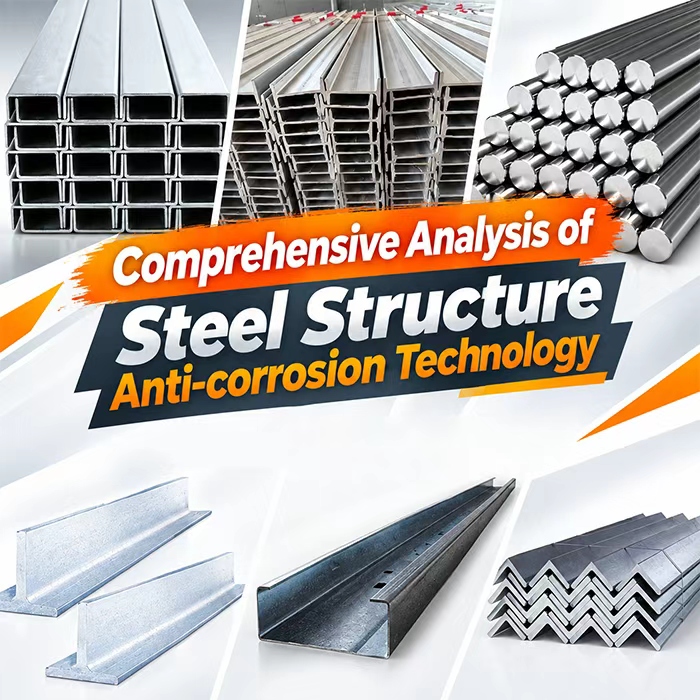
Comprehensive Analysis of Steel Structure Anti-corrosion Technology
As an indispensable load-bearing material in engineering construction, the quality of anticorrosion treatment for structural Steel Structure directly determines the lifespan and safety of a building. Drawing on current standards and twenty years of engineering practice, this article provides a systematic analysis of the mechanisms of steel rusting, anticorrosion systems, and key points for construction quality control.
一 . Causes and Hazards of Structural Steel Corrosion
Electrochemical corrosion occurs when the steel surface comes into contact with oxygen and moisture; chloride ions (present in marine or industrial environments) accelerate the breakdown of the passivation layer. Corrosion can result in a 15%–30% loss of the structural steel’s effective cross-sectional area, with the consequent reduction in strength directly compromising the structure’s load-bearing capacity. A 2023 case study involving an industrial facility revealed that an unprotected H-beam exhibited a corrosion depth of 2.1 mm over three years, creating a risk of structural joint instability.
二. Core Specifications for the Anticorrosion Technology System
Current standards adhere to GB/T 28699-2012, “General Technical Standard for Protective Coating of Steel Structures,” in conjunction with the ISO 12944-2018 classification of corrosive environments (C3–C5). Key parameters are as follows:
(一) Base Material Protection
1. Weathering steel: Q355NH profiles are selected; the addition of 0.2–0.5% Cu, P, and Cr elements increases the density of the oxide layer by 40%.
2. Composite steel: 304L stainless steel-clad profiles; resistance to chloride ion corrosion is ten times that of ordinary carbon steel.
(二) Surface Protective Layer
| Process type | Technical index | Applicable scene |
| Arc zinc spraying | Porosity <5%, bonding strength ≥6MPa | Marine engineering (Design life ≥30 years) |
| epoxy zinc rich primer | Zinc powder content ≥ 80%, dry film thickness > 75 um | industrial factory building |
| epoxy zinc rich primer | With an addition amount of 0.5%, it can withstand salt spray for 4,000 hours | Acid rain corrosion area |
(三) Construction Control
Storage environment: Humidity ≤ 60%; materials must be elevated at least 300 mm off the ground.
Laser derusting: 3000W equipment is used; the processing time is approximately 15–20 minutes per side, with a maximum of 40 minutes per member for heavily rusted areas. Field measurements from a 2024 warehouse project in Zhengzhou indicate that the steel surface cleanliness reached the Sa2.5 grade after laser derusting; when combined with the application of an epoxy zinc-rich primer, coating adhesion improved by 26%.
Comprehensive Analysis of Steel Structure Anti-corrosion Technology
三. Strategies for Challenging Environments
(一) Marine Environments
A dual-protection scheme—comprising a 150 μm thermal-sprayed aluminum layer and a silane sealer—was implemented for the Zhoushan Cross-Sea Bridge maintenance project, supplemented by a specialized two-component, solvent-free coating for the splash zone. Acceptance testing confirmed that coating adhesion remained at ASTM D3359 Class 4B, with an estimated anti-corrosion service life exceeding 35 years. A 2023 maintenance assessment indicated that this system extended the maintenance cycle to eight years and reduced average annual maintenance costs by 37%.
(二) Industrial Corrosive Zones
Fluorocarbon topcoats (PVDF-based) were utilized, offering five times the acid rain resistance of conventional coatings; these were paired with migrating corrosion inhibitors (dosage: 1.2 kg/m³) to form a protective molecular film. A hazardous chemical terminal in Zhoushan adopted a triple-protection system—epoxy putty sealer, epoxy micaceous iron oxide intermediate coat, and fluorocarbon topcoat. After five years of exposure to a highly corrosive environment, the corrosion rate in weld areas was successfully controlled at 0.03 mm/year.
(三) Freeze-Thaw Cycle Zones
Superhydrophobic coatings with a contact angle exceeding 150° and elastic polyurea layers with an elongation at break of ≥400% were employed to resolve coating cracking issues in 30°C environments.
Comprehensive Analysis of Steel Structure Anti-corrosion Technology
四. Key Updates to Standards for 2025
1. *Technical Standard for Cold-Formed Steel Structures* (GB/T 50018-2025): Introduces new anti-corrosion indicators and specifies detailing requirements for thick-walled sections (6–20 mm).
2. *Technical Standard for Anti-Corrosion of Building Steel Structures* (JGJ/T 251) (Under Revision): Incorporates new technologies such as graphene coatings and laser rust removal; proposed requirements include:
Potential difference for cold-applied zinc coatings ≤ 50 mV
Rust layer thickness for rust converter application ≤ 100 μm
Comprehensive Analysis of Steel Structure Anti-corrosion Technology
五. Quality Control and Maintenance
(I) Inspection Methods
Coating thickness: Electromagnetic induction method (error margin ±3 µm)
Adhesion: Cross-cut test meeting ASTM D3359 Grade 4B
Electrochemical Impedance Spectroscopy (EIS): Evaluation of protective system durability
(II) Maintenance Intervals
Standard environments: Comprehensive inspection every 5 years (focusing on welded joints); the Zhoushan Jintang Bridge utilized infrared thermography scanning combined with corrosion sensor monitoring, successfully providing early warnings for three instances of hidden corrosion.
Harsh environments: Infrared thermography scanning and corrosion sensor monitoring every 2 years; field data from a coastal power plant indicates that the online monitoring system reduced the incidence of sudden corrosion-related failures by 81%.
Avoid mixing hot-dip galvanizing with arc-sprayed aluminum, as the potential difference between the two materials can trigger galvanic corrosion. A 2024 stadium project employed a system combining graphene-modified coatings with self-healing coatings; acceptance data showed a 43% reduction in maintenance costs.
《Comprehensive Analysis of Steel Structure Anti-corrosion Technology》