
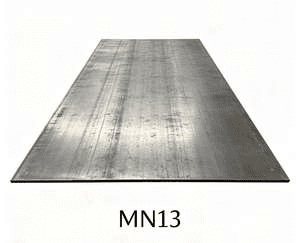
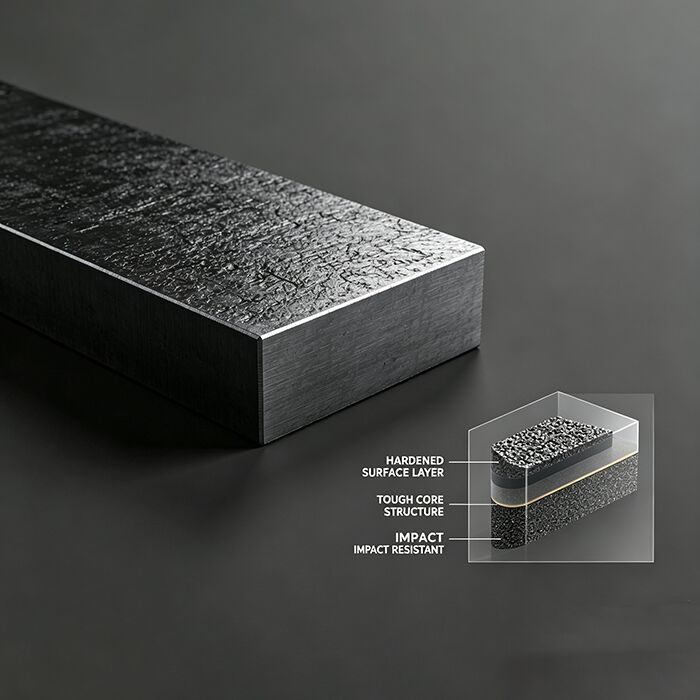
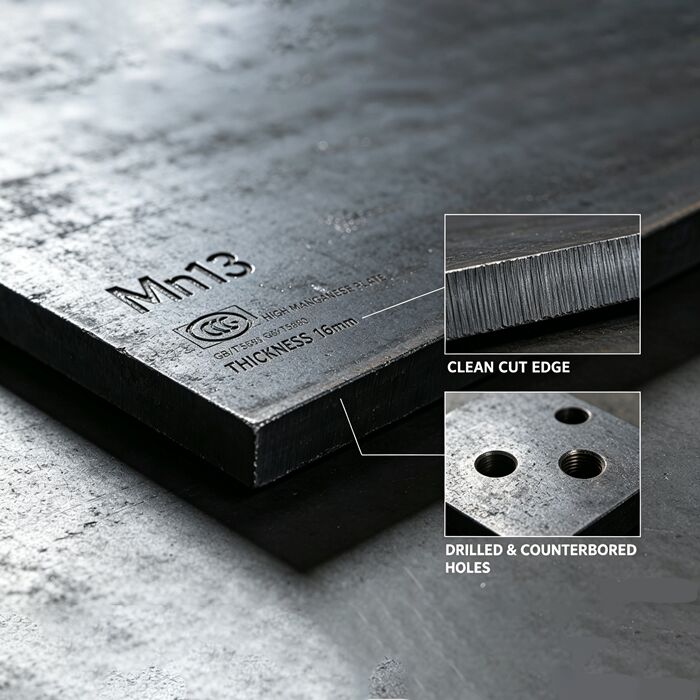
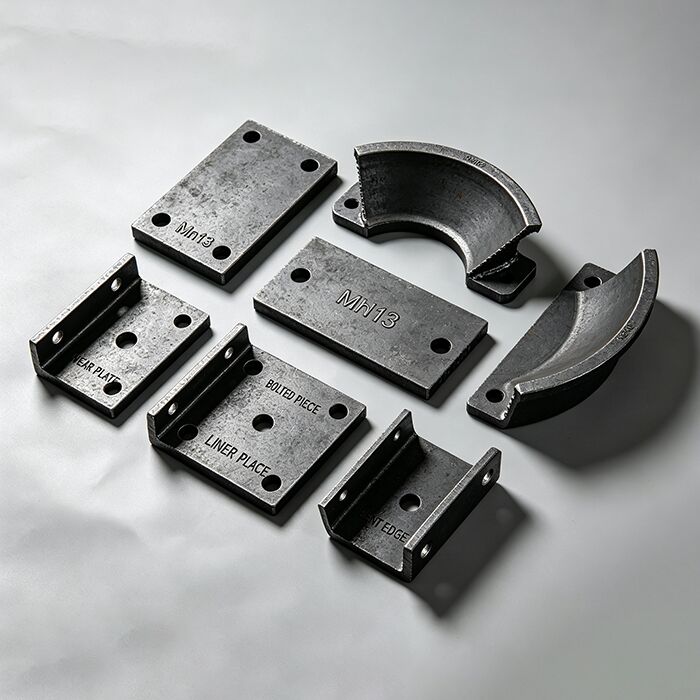
Wear Resistant High Manganese Steel Plate MN13 has a unique property: the harder its surface becomes under impact, the more resilient and crack-resistant its interior remains, and it is also non-magnetic.
International: Hadfield Steel
Domestic: ZGMn13
Thickness range: 3.0 – 40.0 mm
Largeur: ≥ 900 mm
Flatness: ≤ 10 mm/m
Size deviation: Complies with GB standards
Wear Resistant High Manganese Steel Plate MN13 is a typical wear-resistant alloy steel. Its chemical composition is designed around the basic framework of “high manganese and medium carbon“. Mn13 is the representative of high-manganese wear-resistant steel, containing 11%-14% manganese. It has unique work hardening properties. Under impact conditions, it becomes harder and harder, making it an ideal choice for anti-impact and wear-resistant materials.
Mn13 Wear Resistant Manganese Steel Plate is mainly composed of three major elements:
(C): The content is approximately 1.0 – 1.4%. It enhances the hardness and wear resistance of the material, but excessive amounts will make the material brittle.
(Mn): The content can reach as high as 11-14%, which can significantly enhance the toughness of the steel, making the material less prone to cracking when subjected to impact.
Other trace elements: such as silicon (Si), sulfur (S), phosphorus (P), etc., affect the processing performance and surface quality of the materials.
How do the Mn13 High Manganese Wear- Resistant Steel Plates various elements “team up to fight monsters”?
Carbon Manganese CP: The high manganese content significantly increases the solubility of carbon, resulting in a stable austenite structure that can absorb impact energy without cracking.
Silicon assistance: Appropriate amounts of silicon can enhance the yield strength of steel, while also improving the deoxidation effect and making the internal structure purer.
Sulfur and phosphorus Control: Strictly limit the sulfur and phosphorus content (typically < 0.05%), to prevent them from forming brittle inclusions and ensure the overall performance of the material.
“golden rule” for the composition ratio of high manganese wear-resistant Mn13 steel plate:
Manganese-carbon ratio is approximately ≈10:1:This ratio enables the material to rapidly form a hardened layer on its surface when subjected to impact, with the hardness increasing from 200HB to over 500HB.
Low-carbon design: Compared to ordinary high-manganese steel, High Manganese Wear Plate Hot Rolled ASTM A128 Mn13 has a lower carbon content, which not only ensures hardness but also avoids brittleness.
Precise control of trace elements: By precisely adding rare earth elements, the grain size can be further refined, thereby enhancing the overall performance of the material.
(C):0.90% – 1.50%
(Mn):11.00% – 14.00%
(Si):0.30% – 1.00%
(P):≤ 0.070% (
(S):≤ 0.050%
In the raw material procurement process of HNJBL Company, we strictly control the quality of each batch of MN13 steel. Our production process strictly follows the ISO9001 quality management system. From the entry of raw materials into the factory to the delivery of finished products, every step has set strict quality control points to ensure that we can provide customers with high-quality China GB MN13. In addition, we offer a complete after-sales service system to customers, including technical consultation, quality traceability, and after-sales maintenance services, to ensure that customers can use with peace of mind.

The quality certification documents required for MN13 Wear Resistant Steel Plates produced by different steel mills are as follows: “Material Certificate (MTC), third-party inspection reports from SGS and BV, heat treatment records, packaging and labeling. “
Mechanical Property Test:
Tensile strength (Rm): ≥ 700 MPa (for some standards, it is ≥ 900 MPa)
Elongation (A): ≥ 40%
Impact absorption energy (Akv): ≥ 90 J at 20℃
Cold bending performance: No cracks in 180° bending (d = 2a)
Hardness Testing:
Initial hardness (HB): 190 – 230 HB
Hardness after Hardening: After impact, it can reach ≥ 500 HB, and the maximum can reach HB 90
Metallographic inspection:
Requirements for the structure: Austenite grain size should reach 5-8 grades.
Carbonization control: No reticular carbides should form to avoid the risk of brittle fracture.
Non-destructive testing (NDT):
Ultrasonic testing (UT): Detects internal cracks, inclusions, pores, etc.
Magnetic particle testing (MT): Suitable for surface and near-surface defects.
Penetrant testing (PT): Detects surface-opening defects.

| MN13 | NM SERIES |
| Contains manganese at 11-14% | Low alloy containing chromium, molybdenum and boron |
| 180-250HB | 370-530HB |
| Impact hardening | Inherent high hardness |
| High impact environment | Low impact grinding |
| Higher cost | High cost performance |
| Component and structure differences: Basic components: Mn13 Manganese content 119-14%, carbon content approximately 1.0%, austenitic structure Initial hardness: Mn13 Wear Resist Steel Plate Wear-resistant Steel Plate Brinell hardness ranging from 180 to 250 HB. The hardness is relatively low when the surface is not hardened. | Component and structural differences: Basic component: Low-alloy structural steel, containing a small amount of alloys such as Cr, Mo, and B. Pure Organizational structure: The matrix is martensite or bainite structure. Initial hardness: NM400 hardness ranging from 370 to 430 HB, NM500 reaching 450 to 530 HB |
Wear resistance mechanism comparison: work hardening: High Manganese Steel 2mm to 100mm Thick Wear Resistant Steel Plate China GB MN13 Under intense impact or compression, the surface layer undergoes rapid plastic deformation and hardens. Hardness increase: Wear Resistant Mn13 Hot Rolled Steel Plate hardness increases from 200HB to 500-600HB or even higher. Structural features: Forms an outer hard and inner ductile structure, with the interior maintaining austenitic toughness. Applicable environment: Suitable for high-impact and high-wear scenarios. | Comparison of Wear Resistance Mechanisms: Inherent Hardness: Enhance the hardenability through alloying elements to directly form a high-hardness matrix Hardening Method: Achieve hardening without relying on external impact Applicable Environments: Suitable for static or low-impact wear environments, such as sliding friction, material friction |
Application scenarios Wear resistance : High impact scenarios: Crusher liners, the surface under impact continuously hardens and becomes more wear-resistant, enhancing wear resistance with usage. | Application scenarios Wear resistance : High impact scenarios: Crusher liners, prone to cracking under strong impact and lacking toughness |
| Selection criteria basis: Impact strength: In high-impact scenarios such as crusher hammers, the wear resistance significantly improves after hardening Wear type: Impact-dominated wear such as ore falling, which is more resistant through dynamic hardening Cost processing: High Manganese MN13 Resistant to Wear Hot Rolled Steel High cost. Welding requires preheating and the processing is difficult | Selection criteria basis: Impact strength: For medium-low impact scenarios such as silo liners, the initial high hardness directly meets the requirements Wear type: Sliding grinding is the dominant factor, such as in sand and gravel transportation, the inherent high hardness is better Cost and processing: Relatively low cost, good weldability, suitable for on-site assembly and installation |
High manganese wear-resistant Mn13 steel plate – Corresponding materials and applications in China:
1. It is a series of high manganese steel with similar components, commonly used for manufacturing excavator bucket teeth, railway turnouts, etc.;
2. It is an improved type of wear-resistant material, suitable for components such as crusher liners and ball mill liners.
China GB MN13 Selection Suggestions and Precautions:
For environments with strong impacts, it is recommended to choose the high manganese steel series; for pure wear conditions, other wear-resistant materials can be considered.
Notes on using the mn13 material:
What is the brand name of MN13 in the international market?
(America) ASTM A128 Grade A / Grade B2
(Germany) 1.3401
(Europe) X120Mn12 or X120Mn13
(Japan) SCMnH1
ISO GX120Mn13
Hadfield Steel
How do the components and heat treatment of MN13 work together?
The final performance of Mn13 Wear Resistant is highly dependent on the matching relationship between “composition and heat treatment”. When the carbon content approaches the upper limit of 1.5%, the solid solution temperature needs to be raised to 1100-1150°C to fully dissolve the carbides. Data from the production of a crusher liner shows that for a material with MN13 Grade Manganese Plates C=1.4%, using a 1120°C x 2h water toughness treatment results in a 23% longer service life compared to the conventional 1050°C treatment. The sensitivity of the cooling rate to the manganese-silicon ratio has a significant impact. When Mn13 High Manganese Wear- Resistant Steel Plates Mn/Si > 25, the material may undergo martensitic transformation under air cooling conditions. This requires strict control of the interlayer temperature not to exceed 250°C during welding repair to avoid the formation of hard brittle phases in the heat-affected zone. A field overlay welding case of a ball mill liner in a power plant indicates that using a welding wire with MN13 Wear Resistant Steel Plates Mn/Si = 28 and a 150°C preheating process can make the hardness of the repaired area reach HB450 or above.
What are the application areas of MN13 Manganese Steel Plates?
Le contrôle total des produits nous permet de garantir à nos clients des prix et un service de la meilleure qualité. Contactez-nous pour un devis gratuit, JBLSTEEL vous fournira la bonne solution pour votre projet.
 English English Русский Deutsch Español 简体中文 Português Italiano 日本語 Bahasa Indonesia 한국어 Français Nederlands العربية Tiếng Việt ไทย Tagalog Bahasa Melayu Polski Türkçe Português do Brasil हिन्दी Қазақ тілі বাংলা
  Hausa Kiswahili አማርኛ فارسی Ελληνικά Română Українська English English Русский Deutsch Español 简体中文 Português Italiano 日本語 Bahasa Indonesia 한국어 Français Nederlands العربية Tiếng Việt ไทย Tagalog Bahasa Melayu Polski Türkçe Português do Brasil हिन्दी Қазақ тілі বাংলা Hausa Kiswahili አማርኛ فارسی Ελληνικά Română Українська
Automated page speed optimizations for fast site performance
