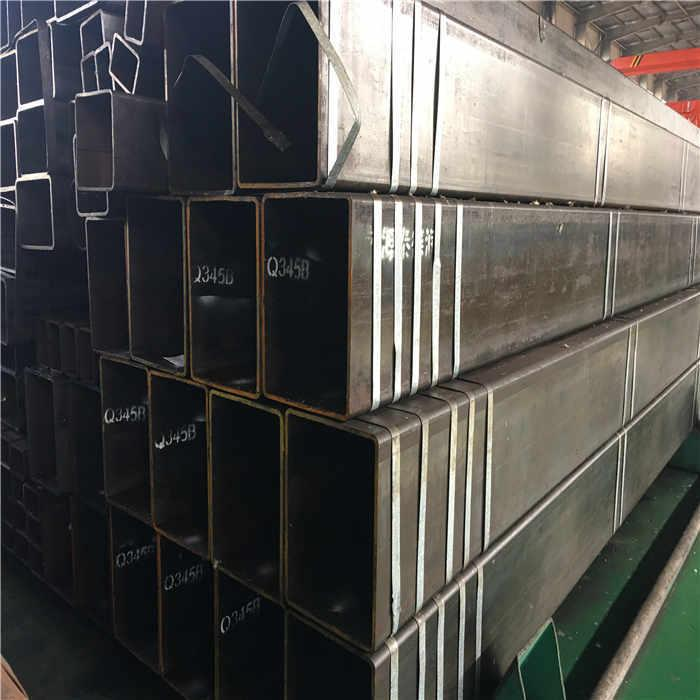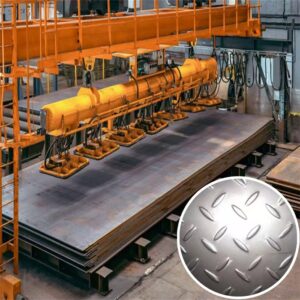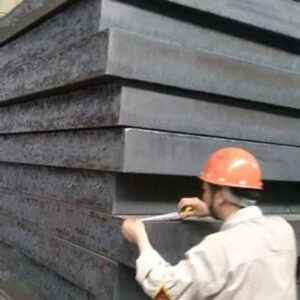
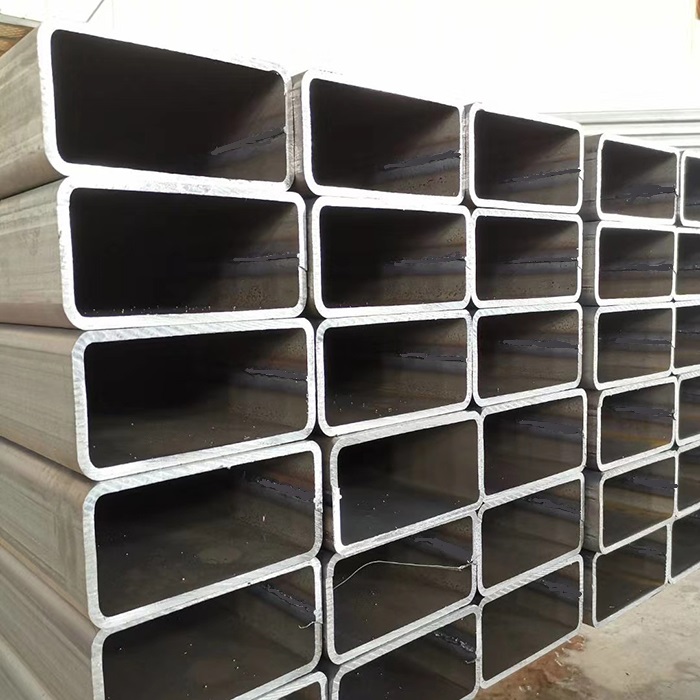
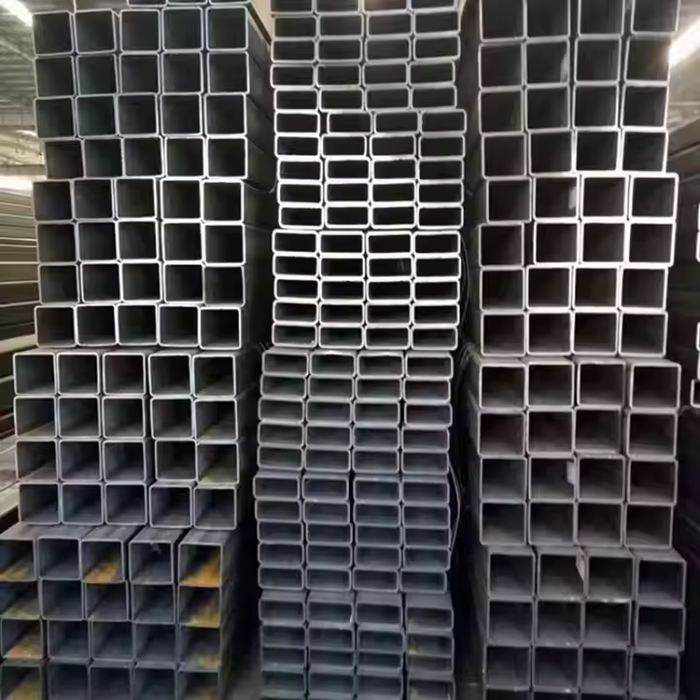
Mild Steel Q345qd Hot Rolled Carbon Square and rectangular tubes Steel for Bridge Building supports 180° cold bending without cracking, with a bend diameter ≤2 times the plate thickness, and offers anti-laminar tearing grades up to Z15/Z25/Z35, meeting the requirements for thick plates (>40mm).
“Q” represents the yield strength.
“345” indicates the minimum yield strength of 345 MPa.
“q” refers to steel for bridges.
“D” – 20℃ low-temperature impact toughness.
“JINBAILAI company Mild Steel Q345qd Hot Rolled Carbon Square and rectangular tubes Steel for Bridge Building features a core advantage of a 345MPa yield strength and -20℃ impact toughness. Through the use of niobium-vanadium alloy and TMCP technology, it achieves a balance between high strength and low-temperature toughness. It has been successfully applied to super projects such as the Hong Kong-Zhuhai-Macao Bridge, and will lead the 80 billion high-end welded pipe market in the future.”
Delivery form of the interface pipe
Square-section pipes can be delivered in the form of interface pipes, but the user needs to remove the interface pipes during use. This form is suitable for scenarios that require on-site connection, such as extremely long structures or projects with restricted transportation.
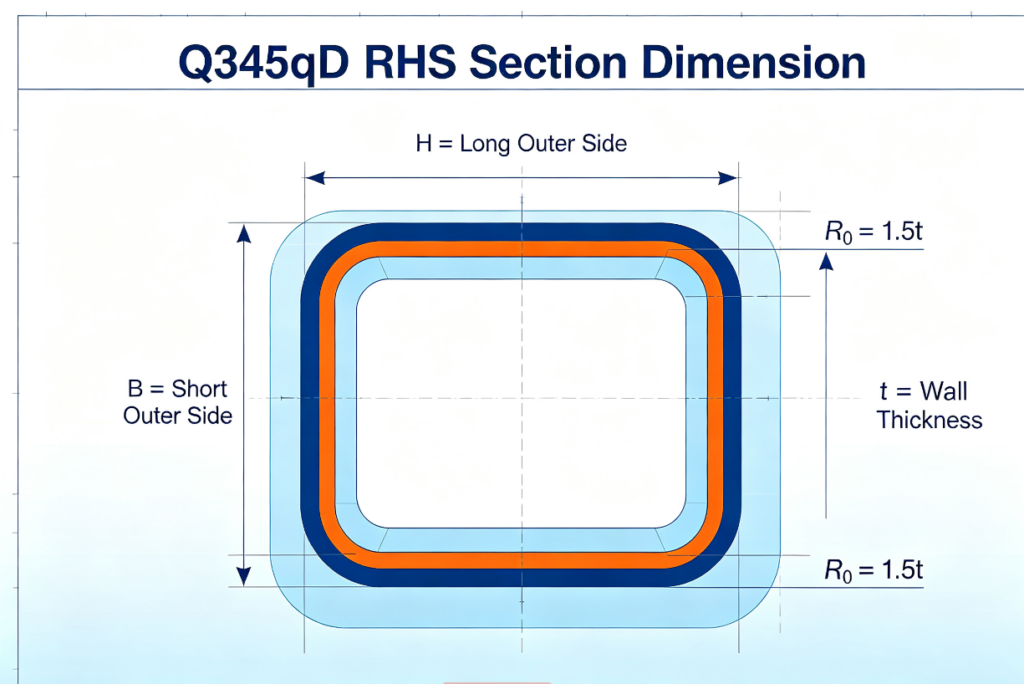
Dimensions of Q345qD square and rectangular tubes
Square tube dimensions: Side length 20 – 600mm,4000-12000mm
Rectangular tube dimensions: 20 – 800mm
Wall thickness range: 1.5mm – 30mm
Standard lengths: 6 meters, 12 meters
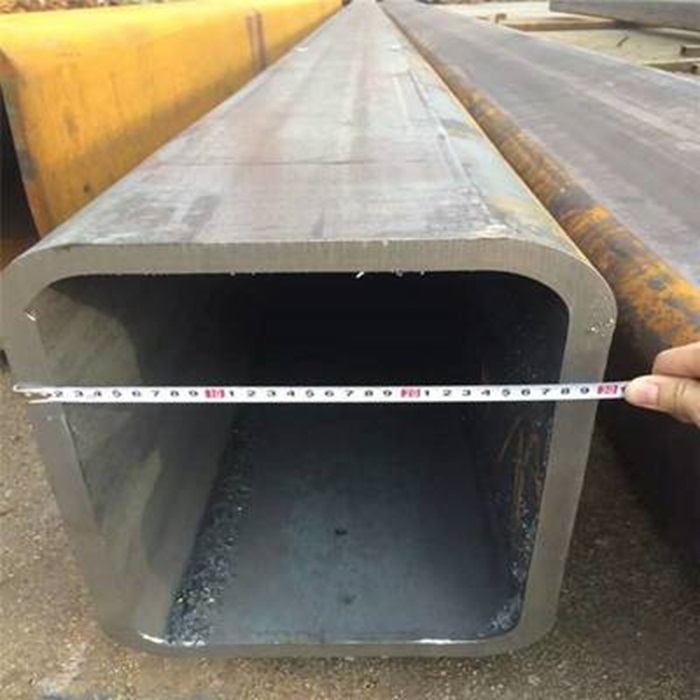
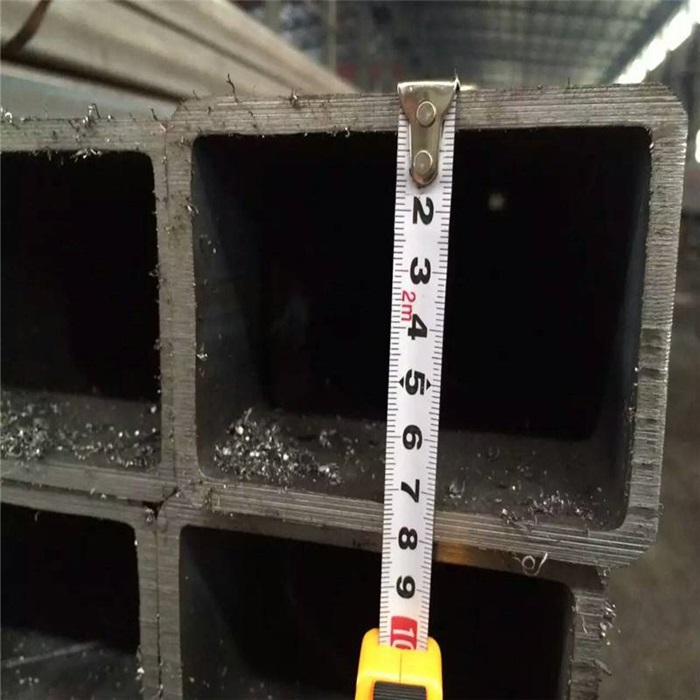
How do you measure the size of steel Q345qD?
Q345QD square and rectangular tubes are generally used for:
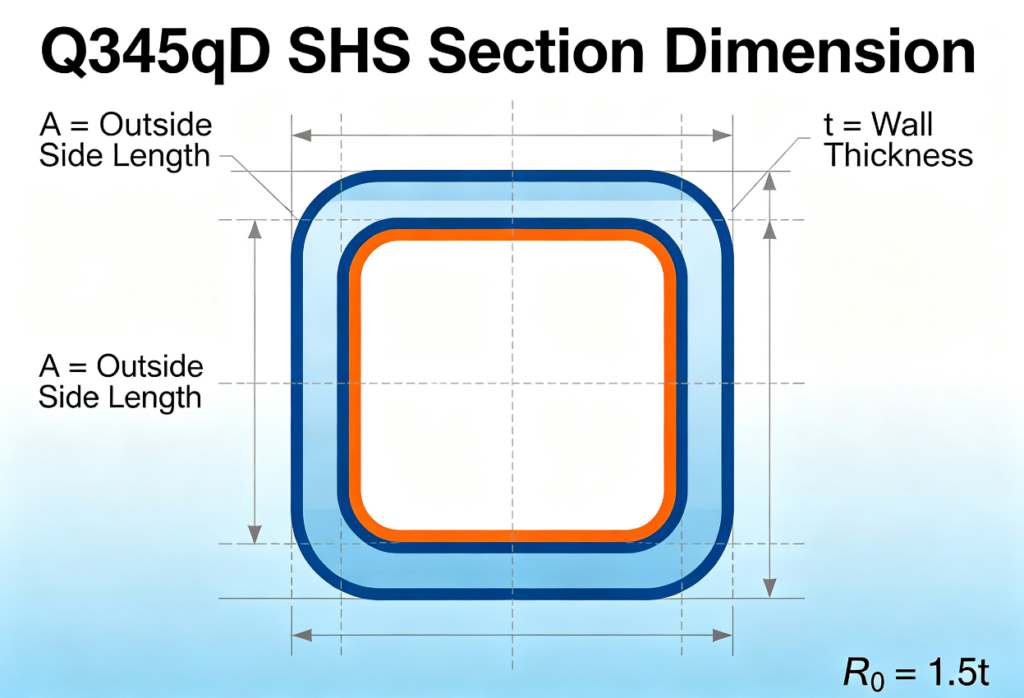
Outside dimension × Outside dimension × Wall thickness × Length
It is stated, for example:
200×200×10×12000 mm
Meaning:
200 mm = Outer side length A of the square tube
200 mm = Outer side length B of the square tube
10 mm = Wall thickness T
12000 mm = Length L (commonly 6 meters or 12 meters)
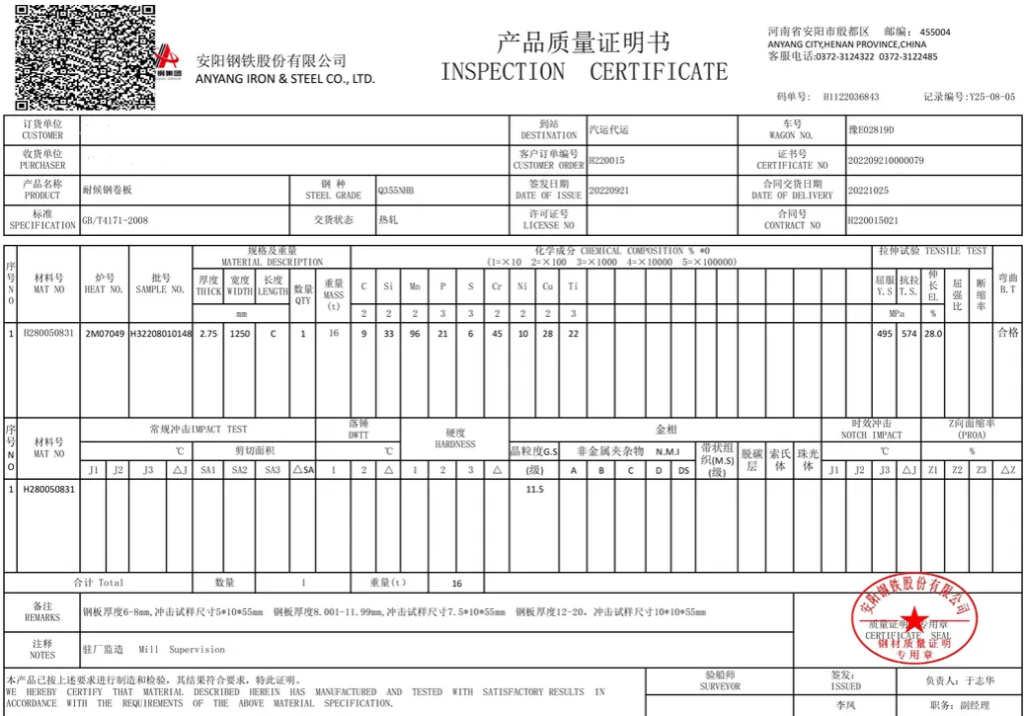
Q345QD Chemical Elements:
(C):≤0.18%
(Si):≤0.50%
(Mn):0.90%–1.60%
(P):≤0.025%
(S):≤0.025%
(Als):≥0.015%
microalloy elements:Nb≤0.045%、V≤0.08%、Ti≤0.20%
residual elements:Cr、Ni、Cu residual elements≤0.30%
Q345QD Mechanical Properties:
(Yield Strength):≥345 MPa
(Tensile Strength):
(Elongation):≥20%(
Low-temperature impact toughness : Under the condition of -20℃, the V-notch impact energy (KV2) must meet specific standards (usually ≥34J) to ensure the safety of bridge structures in cold regions.
Q345QD Tolerance:
Wall thickness tolerance: ±10%
Edge length/form size deviation: ±0.75% to ±1.0%
Bending degree: no more than 2.0mm
End head skewness: no more than 2.0mm
Q345QD Surface Quality:
The surface must not have any bubbles, scars, cracks, folds, inclusions, or indentations of iron oxide. It is also necessary to ensure that the cut is smooth, without burrs or obvious distortions.
Q345QD Welding:
Use low-hydrogen welding materials (E5015/J507 or matching flux-cored welding wire). When the plate thickness is greater than 25mm or the ambient temperature is lower than 0℃, preheating to 100–150℃ is mandatory. Strictly control the line energy to prevent the thermal affected zone from becoming brittle. After welding, perform 600–640℃ stress-relieving heat treatment based on the thickness, and conduct 100% non-destructive testing to ensure that the -20℃ impact toughness meets the requirements.
What types of Q345qD square and rectangular tubes are there?
1. According to production process
° Seamless square and rectangular tubes
° Welded square and rectangular tubes
2.According to the cross-sectional shape
° Square tube
° Rectangular tube
3. According to surface condition
° Black pipe (bare pipe)
° Galvanized pipe
° Other coatings
What are the types of Q345qD?
1. According to the additional performance requirements:
° Ordinary Q345qD: Only meets -20℃ impact toughness;
° Z-direction performance type: Q345qD-Z15/Z25/Z35
° Weather-resistant composite type: Q345qDNH
What are the different types of Q345?
Q345A: No impact test required, no mandatory requirement for low-temperature toughness
Q345B: 20℃
Q345C: 0℃
Q345D: -20℃
Q345E: -40℃
Why do so many people choose JBL’s Q345?
The core advantage of Q345D square tubes lies in the balance between mechanical properties and processing adaptability. Its yield strength exceeds 345 megapascals, and Q345 Rectangular Steel Pipe and Square Steel Tube the tensile strength ranges from 470 to 630 megapascals. The elongation rate is usually over 21%, which means it can both resist deformation and have certain ductility when bearing loads, and is less likely to suddenly break. Development of Q345qD Thicker Bridge Steel Plate of 130mm,Trace amounts of alloy elements such as vanadium, titanium, and niobium are added to the material, which refine the grains and enhance the welding performance – under conventional manual arc welding, gas shielded welding, or submerged arc welding processes, as long as the preheating temperature is properly controlled (generally not lower than 100°C), the weld seam heat affected zone is less likely to develop cold cracks. In addition, Q345 low carbon steel require an impact energy of no less than 34 joules (-20°C) in the cold environment, Q345q Series | Structural Steel for Bridge enabling them to maintain reliable operation in northern cold regions or outdoor structures of cold chain facilities.
Is Q345QD resistant to low temperatures?
yes
What are the differences between Q345QD and Q345B?
| “Comparison dimension” | Q345qD (steel for bridge) | Q345B (General-purpose structural steel) |
|---|---|---|
| Meaning of grade | Q(bend)+345(strength)+q(bridge)+D(grade) | Q(Bend)+345(strength)+B(Grade) |
| executive standard | GB/T 714 (Steel for bridge structures) | GB/T 1591 (Low-Alloy High-Tensile Structural Steel) |
| main application | It is specifically used for the main beams and key load-bearing components of railway/highway Bridges | General structures such as buildings, vehicles, and general machinery |
| Impact test temperature | -20℃ (High low-temperature toughness is required) | 20℃ (Impact at normal temperature) |
| (P) Content upper limit | ≤ 0.025% | ≤ 0.040% |
| (S) Content upper limit | ≤ 0.025% | ≤ 0.040% |
| (C) Content upper limit | ≤ 0.18% | ≤ 0.20% |
| Performance focus | High toughness, fatigue resistance, atmospheric corrosion resistance and good weldability | It has good comprehensive mechanical properties and a relatively low cost |
Can Q345QD square and rectangular tubes be exported?
yes
What is the biggest difference between Q345QD square/rectangular tubes and ordinary square tubes?
Q235 square tubes are widely used in ordinary building frameworks. Their yield strength meets the basic load-bearing requirements and the cost is relatively low. On the other hand, Q345 square and rectangular tubes, due to their higher strength and toughness, are more suitable for scenarios with higher requirements for load-bearing capacity, such as large bridges and heavy machinery.
Is Q345QD square and rectangular tube resistant to fatigue?
better.
What raw materials are used for Bridge Building Q345qd?
Q345QD hot-rolled steel coil / Q345QD steel plate
Does the thickness of the raw material affect the performance of square and rectangular tubes?
yes
large thick plate bridge steel of Q345qD develop residual stress?
yes
Can Q345qD steel plates are structural steel plates undergo secondary welding?
yes
Are Q345QD square and rectangular tubes suitable for high-rise buildings?
yes
How can large thick plate bridge steel of Q345qD be protected against rust?
Hot-dip galvanizing / Spray coating composite coating / Paint coating / Gas-phase rust prevention / Cathodic protection
Il controllo completo sui prodotti ci permette di garantire ai nostri clienti i prezzi e il servizio migliori. Contattateci per un preventivo gratuito, JBLSTEEL vi fornirà la soluzione giusta per il vostro progetto.