
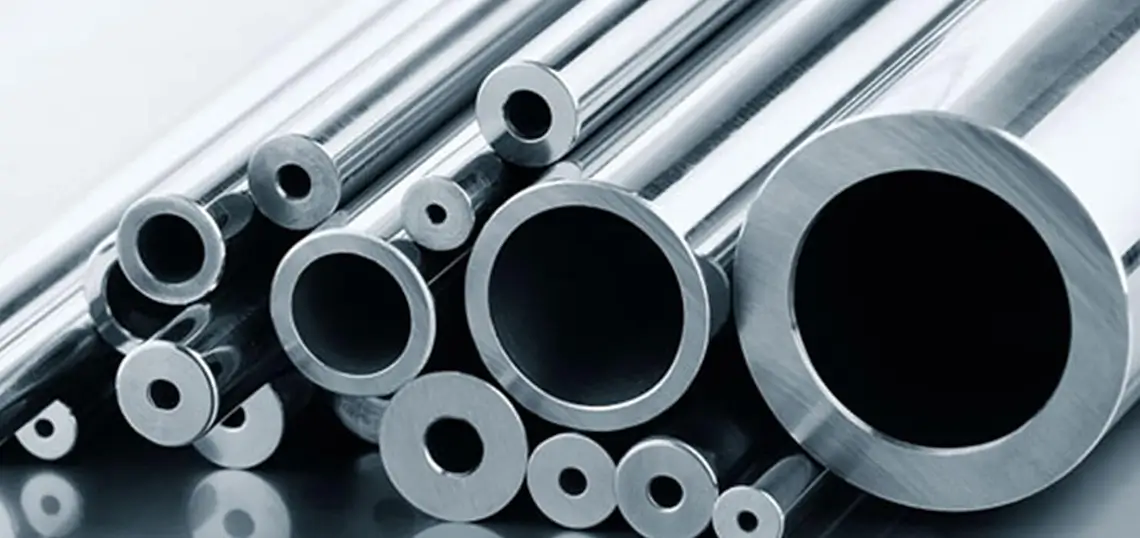
Both 304 and 410 stainless steel are common stainless steel materials with certain corrosion resistance and heat resistance. This blog explores the key differences between 410 stainless steel Vs 304, systematically comparing and analyzing the composition, properties, and applications of these two common stainless steels to help you make the best material selection decision.
410 Stainless Steel:
A type of martensitic stainless steel, its primary components include chromium (11.5%-13.5%) and carbon (0.08%-0.15%), with no nickel or extremely low nickel content. It features a body-centred cubic crystal structure and exhibits magnetic properties.
410 stainless steel offers high tensile strength and hardness but low elongation, which means it has poor toughness. It exhibits excellent mechanical properties and hardness, making it suitable for applications requiring high strength and wear resistance.
The most common austenitic stainless steel, primarily composed of chromium (18%-20%) and nickel (8%-10.5%), with low carbon content (approximately 0.08%). Its crystal structure is face-centered cubic, non-magnetic or weakly magnetic.
เหล็กinox 304 exhibits high elongation and plasticity, making it suitable for forming or bending.
What's the Difference Between 410 and 304 Stainless Steel?
Chemical Composition: 410 Stainless Steel vs 304
| เกรด | C | Mn | Si | P | S | Cr | Ni |
| 304 | ≤0.08 | ≤2.00 | ≤1.10 | ≤ 0.045 | ≤ 0.030 | 18.0-20.0 | 8.0-10.5 |
| 410 | ≤0.15 | ≤1.0 | ≤1.0 | ≤ 0.035 | ≤ 0.030 | 11.5-13.5 | – |
410 Stainless Steel:
Primarily composed of iron and chromium (Cr content approx. 11.5%-13.5%), with relatively high carbon content (approx. 0.15%) and no nickel. Due to its high carbon content, it can gain high strength and hardness through heat treatment.
Primarily composed of iron, chromium, and nickel. With a high chromium content (18%-20%) and 8%-10.5% nickel. The addition of nickel provides excellent corrosion resistance and toughness.
410 vs 304 Stainless Steel: Corrosion Resistance
410 Stainless Steel:
Poor corrosion resistance. Although it contains chromium, it lacks nickel, making it prone to corrosion especially in acidic, alkaline, or chloride-containing environments (such as seawater). Its corrosion resistance primarily relies on surface hardening (polishing).The resistance to pitting corrosion and chloride ion corrosion is far inferior to that of 304.
Excellent corrosion resistance. The high chromium and nickel contents provide exceptional resistance to atmospheric exposure, seawater, acids, alkalis, and food media. It also remains corrosion-resistant for extended periods even in humid atmospheres and freshwater environments. Widely used in food processing, medical devices, and related fields.
Strength and Hardness
410 Stainless Steel:
High Strength and Hardness: Can achieve extremely high hardness through heat treatment (e.g., quenching, tempering), reaching Rockwell hardness HRC 35-50 or higher. Tensile strength and yield strength are also high.
Relatively Low Toughness: Due to the characteristics of its martensitic structure, its impact toughness and ductility (elongation) are typically inferior to 304.
Excellent toughness: High ductility (elongation ≥40%), resistant to brittle fracture even in low-temperature environments.
Lower hardness: Generally, lower hardness in the normal state; strength is typically enhanced through cold working, but cannot achieve the extremely high hardness of 410 through heat treatment.
410 Stainless Steel vs 304 Price
410 stainless steel has a lower cost because it does not contain nickel;
เหล็กinox 304 has a high nickel content, resulting in a relatively higher cost.
Application
410 Stainless Steel:
Suitable for cutting tools, valves, pump shafts, impellers, welding filler metals, and other components requiring high strength, wear resistance, or magnetic properties.
Suitable for kitchenware, tableware, storage tanks, medical devices, chemical containers, and environments requiring frequent cleaning and food contact.
How to Choose 410 Stainless Steel or 304?
For high-corrosion environments (such as seawater, acidic, or alkaline conditions) or applications requiring long-term exposure with high rust resistance, 304 material should be the preferred choice.
410 Stainless Steel:
For applications emphasizing load-bearing capacity, wear resistance, and high-temperature performance (e.g., machine tool components, cutting tools, heat exchange tubes), 410 offers superior cost-effectiveness.
Additionally, due to its higher nickel content, 304 is significantly more expensive than 410. When budgets are tight and low corrosion resistance requirements, 410 can deliver substantial cost savings.
Conclusion
Choose 410 or เหล็กinox 304 based on your specific requirements. For projects prioritizing high strength, high hardness, and budget constraints, 410 stainless steel is recommended. For applications demanding exceptional corrosion resistance and formability, เหล็กinox 304 is a better choice.

 English
  Русский
  Deutsch
  Español
  简体中文
简体中文  Português
  Italiano
  日本語
日本語  Bahasa Indonesia
  한국어
한국어  Français
  Nederlands
  العربية
  Tiếng Việt
  ไทย
ไทย  Tagalog
  Bahasa Melayu
  Polski
  Türkçe
  Português do Brasil
  हिन्दी
  Қазақ тілі
  বাংলা
বাংলা  Hausa
Hausa  Kiswahili
  አማርኛ
አማርኛ  فارسی
فارسی  Ελληνικά
  Română
  Українська