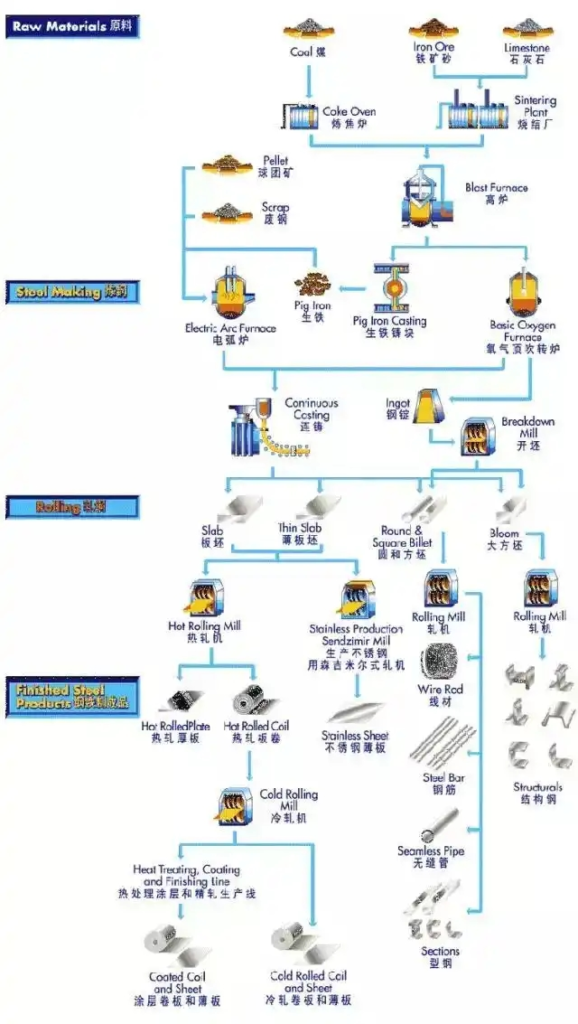
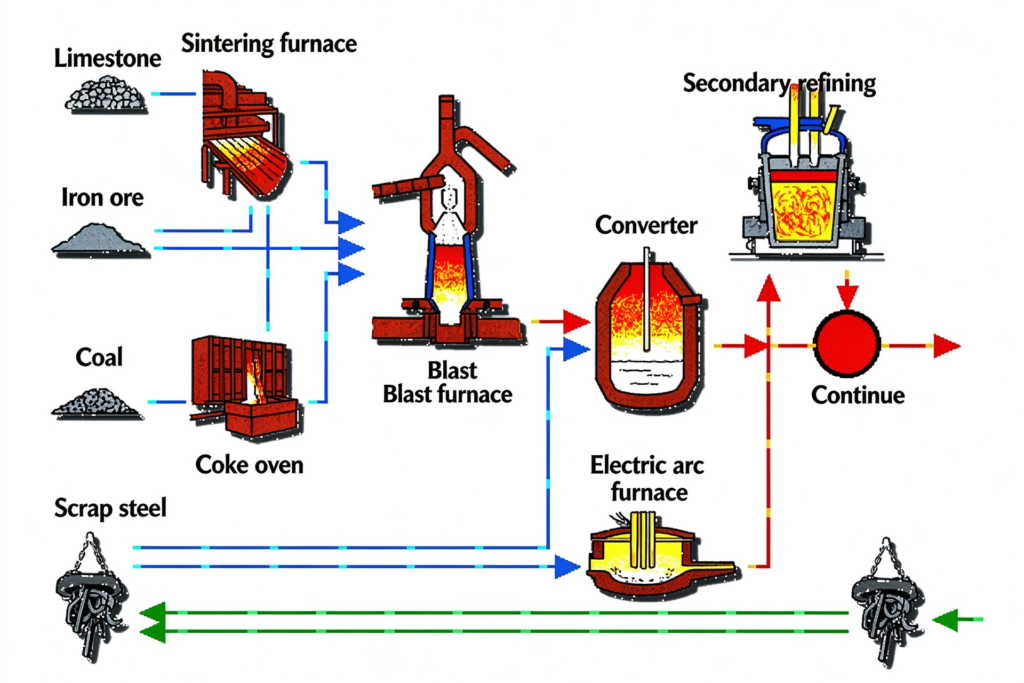
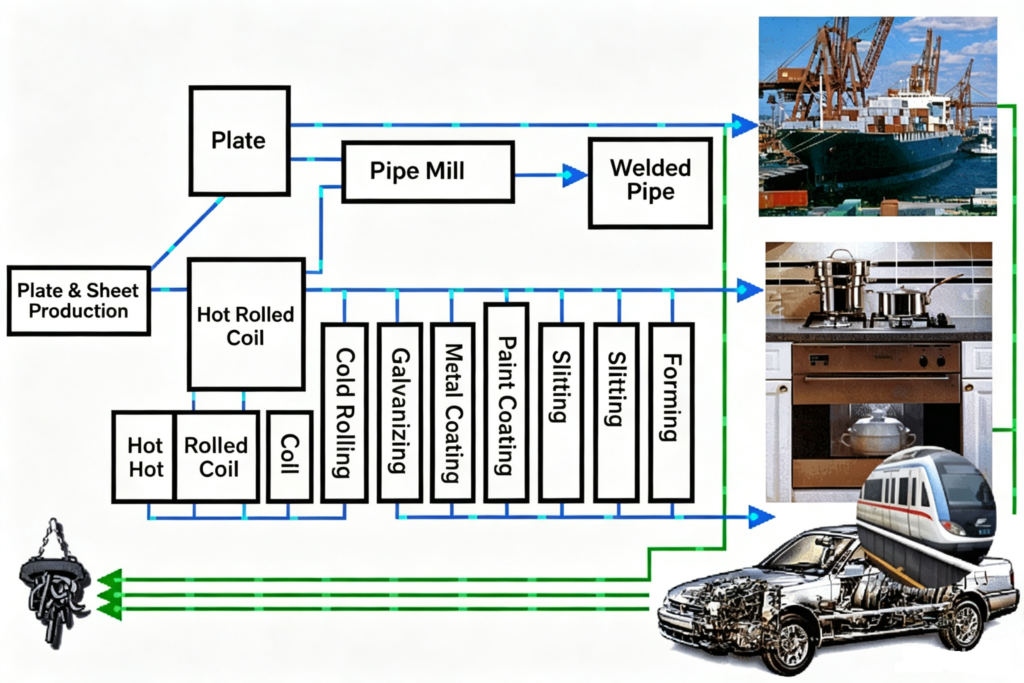
Steel products are created through a series of processes—starting from iron ore and proceeding through continuous sintering, smelting, rolling, heat treatment, and machining. Let’s take a look at the steel production process.
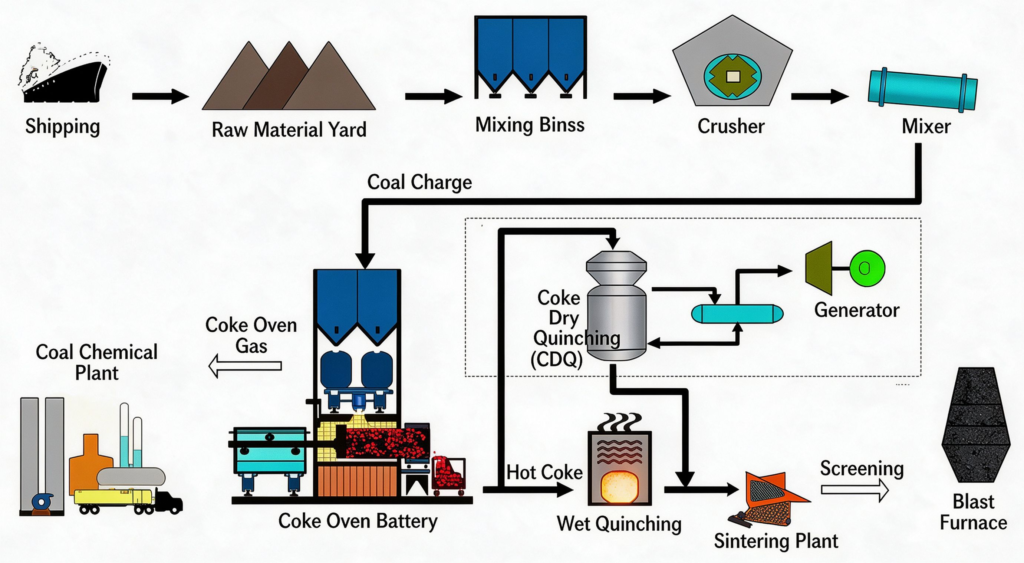
Coke production process: Coking is a process in which coking coal is mixed and crushed, then charged into a coke oven and subjected to dry distillation to produce hot coke and crude coke oven gas.
2. Sintering production process
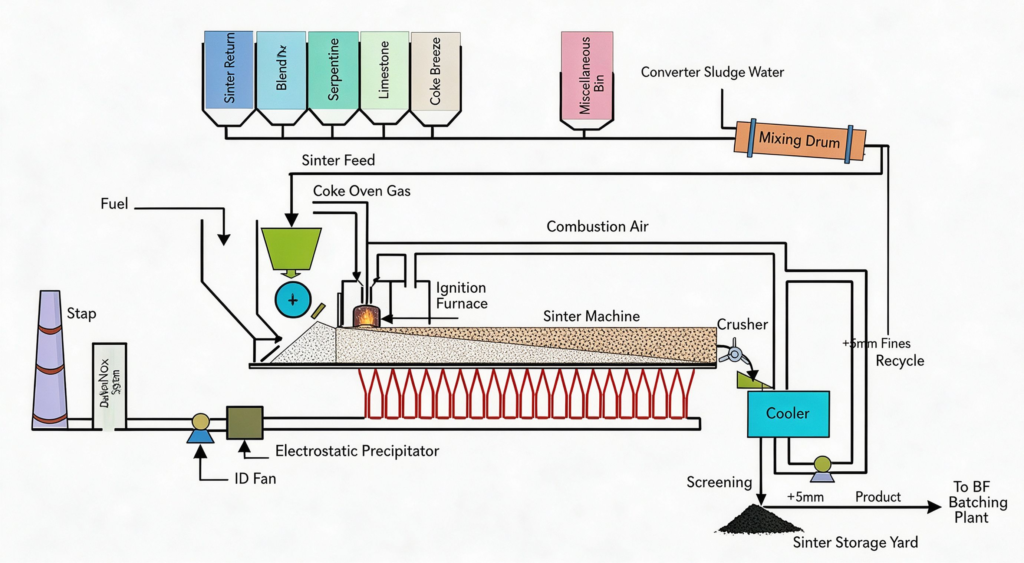
Sintering production process: The sintering operation is to mix and granulate the pulverized iron ore, various fluxes and fine coke, then add it to the sintering machine through the distribution system. The fine coke is ignited by the ignition furnace, and the sintering reaction is completed through the exhaust windmill. After the high-heat sinter is crushed, cooled and screened, it is sent to the blast furnace as the main raw material for smelting molten iron.
3. Blast Furnace Production Process
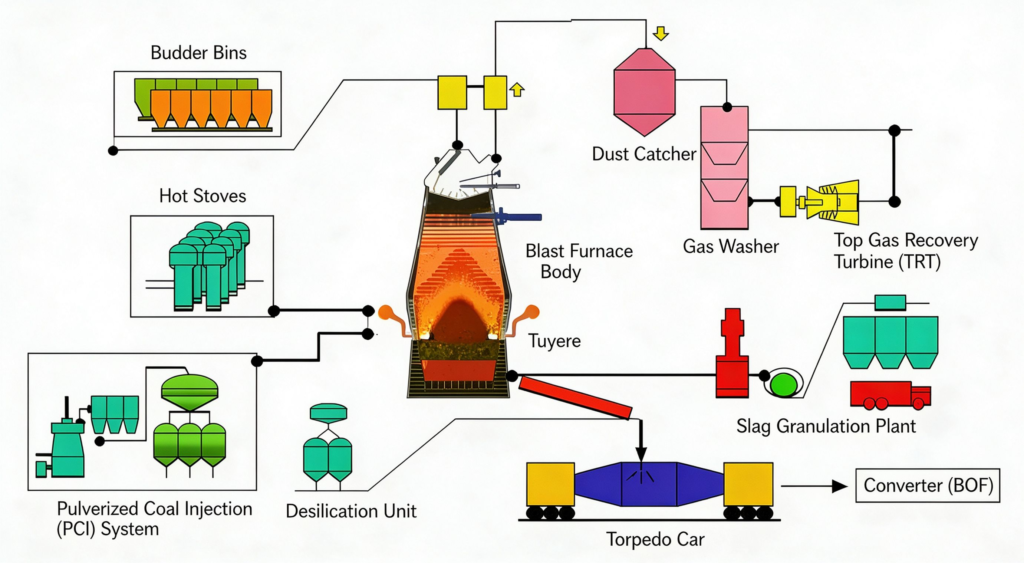
Blast Furnace Production Process: Blast furnace operations involve charging iron ore, coke, and flux into the furnace from the top and blowing high-temperature hot air through tuyeres at the lower section. This generates reducing gases that reduce the iron ore, resulting in the production of molten iron and slag.
4. Converter production process
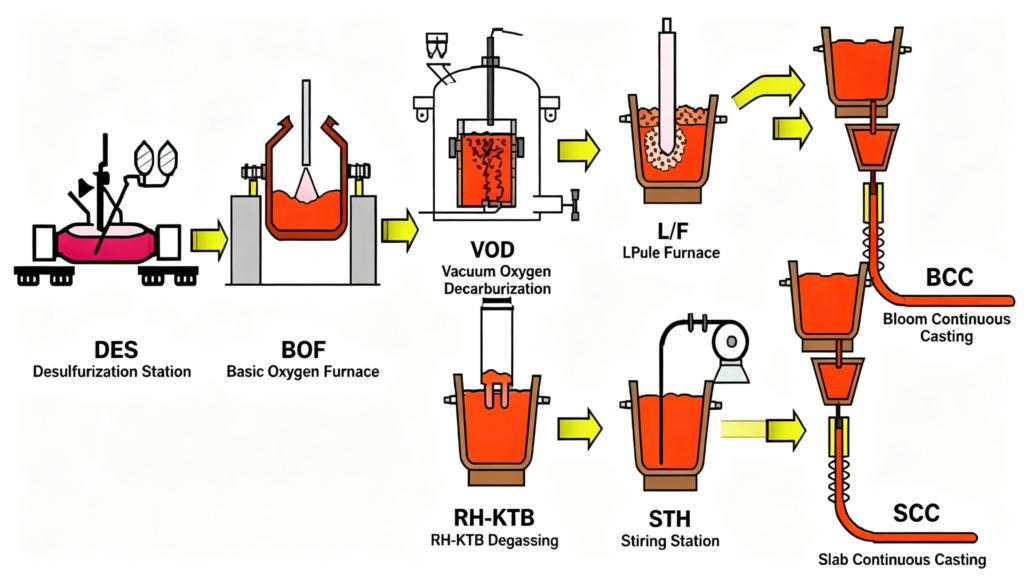
The basic oxygen furnace (BOF) production process begins with the transfer of molten iron to a pretreatment station for desulfurization and dephosphorization. Following oxygen blowing in the converter, the molten steel undergoes secondary refining—tailored to the specific grade and quality requirements of the order—at stations such as RH vacuum degassing, ladle injection, VOD (vacuum oxygen decarburization), or STN stirring units to adjust the chemical composition. Finally, the steel is sent to continuous casting machines for blooms and slabs, where it is cast into red-hot semi-finished products. These undergo inspection and surface conditioning (grinding or scarfing to remove defects) before being sent downstream for rolling into finished products such as bar steel, wire rods, plates, coils, and sheets.
二. Iron and Steel Production Process—Steel Rolling
1. Continuous casting production process
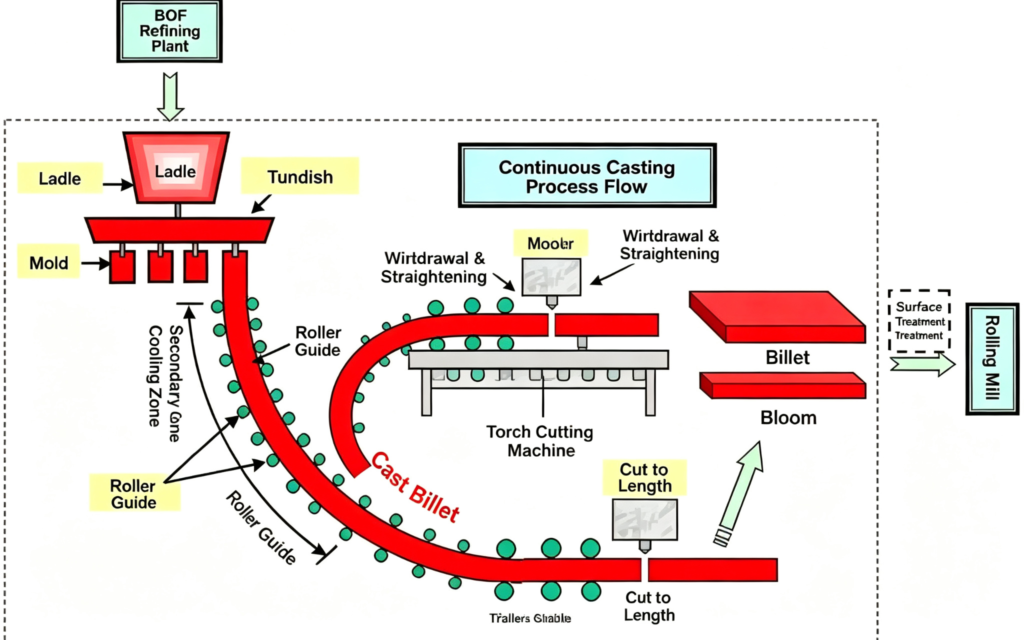
Continuous Casting Process: Continuous casting is the process of transforming molten steel into steel castings (billets or slabs). Molten steel, having undergone upstream processing, is transported via ladle to a turret; it is then distributed through a tundish into multiple streams and poured into molds of specific shapes, where cooling and solidification begin. This forms a casting with a solidified outer shell and a molten steel core. The casting is then withdrawn into an arc-shaped strand guide, where secondary cooling facilitates further solidification until the steel is fully solid. After straightening, the casting is cut to order-specific lengths; square sections are known as “billets,” while rectangular sections are known as “slabs.” Depending on requirements, these semi-finished products undergo surface treatment before being sent to the rolling mill for further processing.
2. Small billet production process
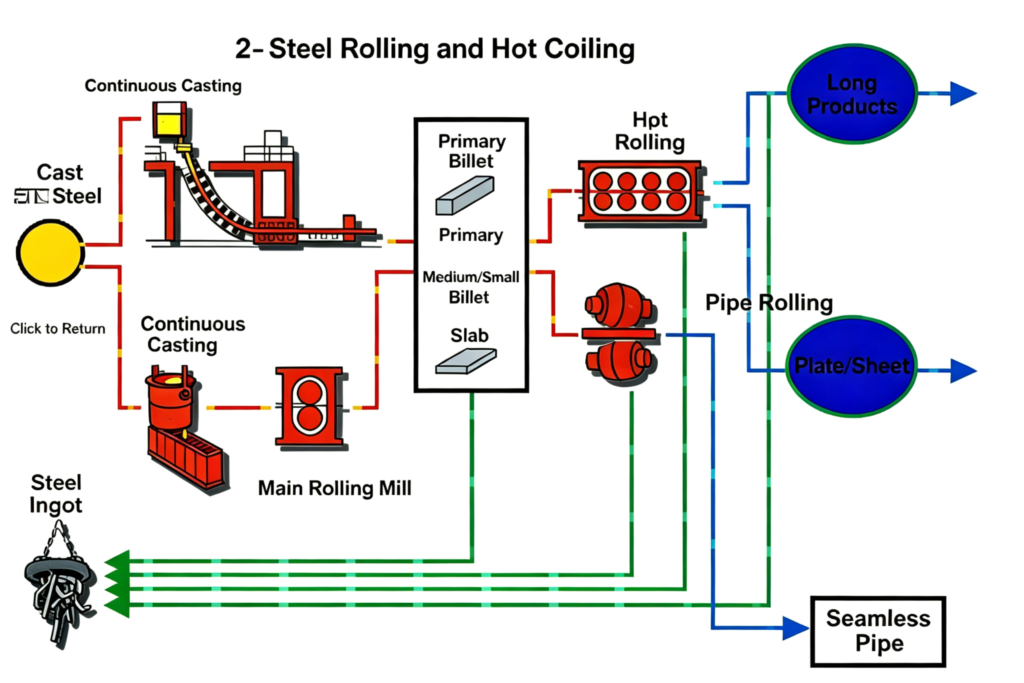
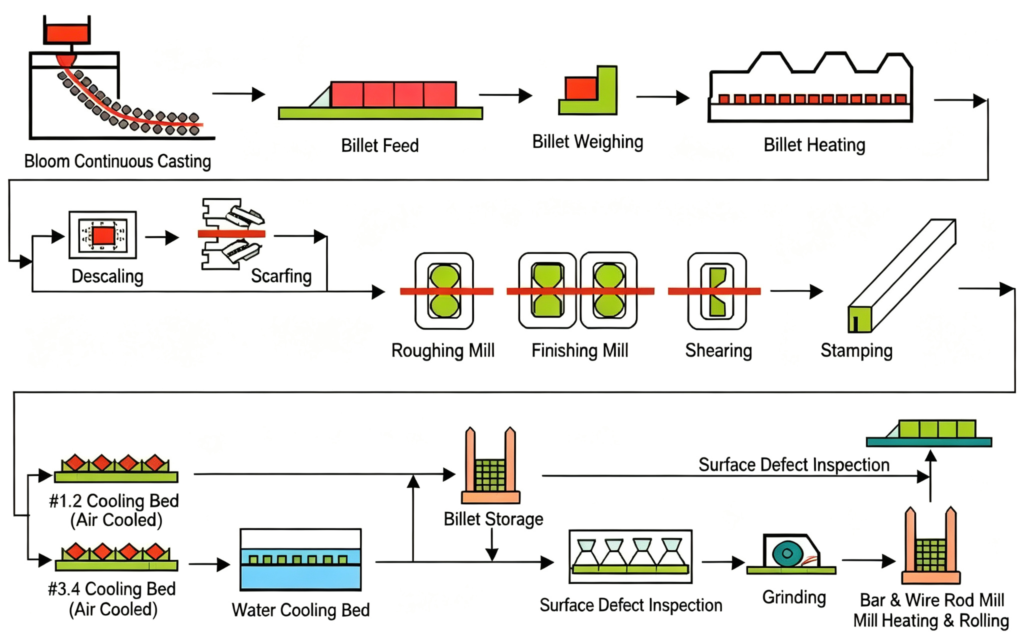
Small Billet Production Process: Large billets produced by the continuous casting machine undergo heating, descaling, scarfing, rough rolling, finish rolling, and shearing to produce small billets with a 118mm x 118mm cross-section. Sixty percent of these small billets undergo inspection and grinding to remove surface defects before being supplied to the bar and wire mills for rolling into steel bars, wire rods, and straight bars.
3. Hot-rolled steel production process
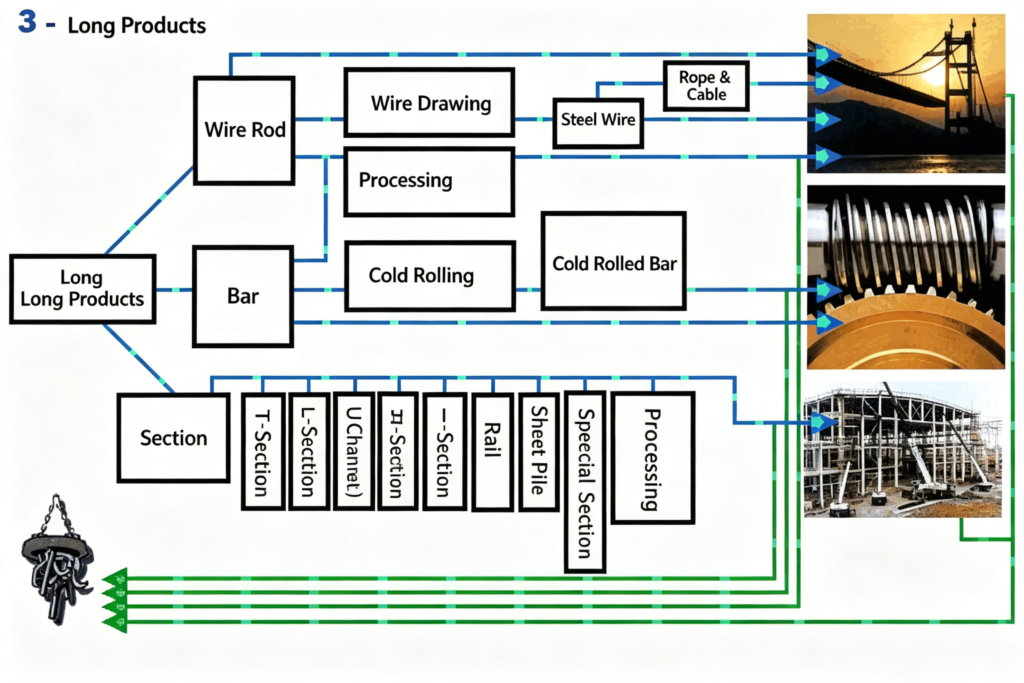
Hot rolling involves heating the material either during or prior to the rolling process; typically, the material is heated above its recrystallization temperature before rolling takes place. Hot-rolled products are characterized by high strength, good toughness, ease of forming, and excellent weldability, making them widely used in manufacturing sectors such as shipbuilding, automotive, bridge construction, architecture, machinery, and pressure vessels.
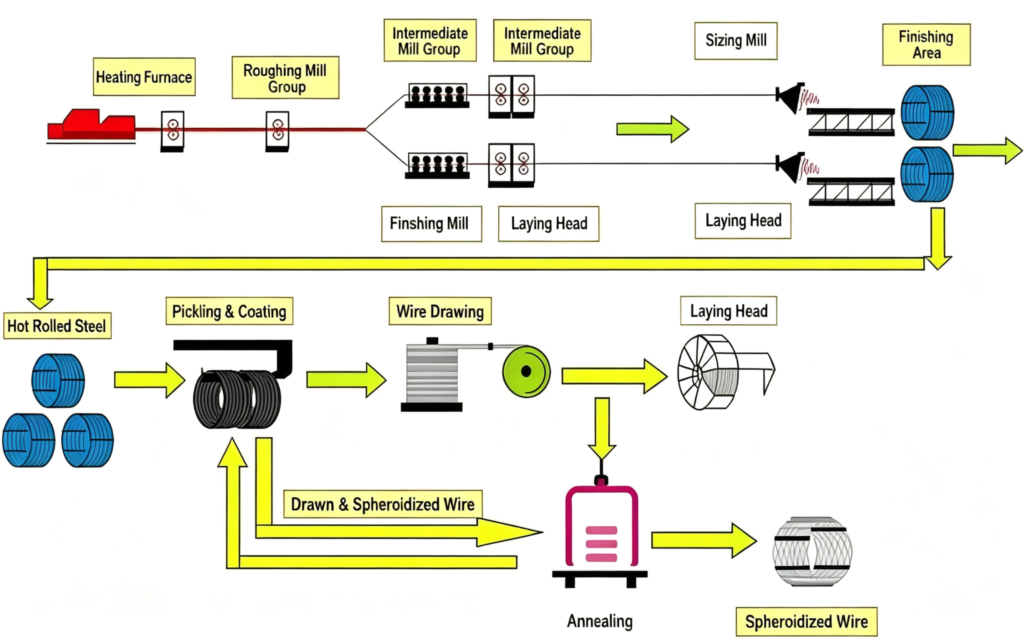
Wire rod production process: Small steel billets are heated in a furnace and then rolled through roughing, intermediate, and finishing mill stands, as well as a reducing and sizing unit. The material is then coiled, transported via a cooling conveyor, and sent to the finishing area. Products requiring further processing undergo additional steps such as pickling and coating, wire drawing, and annealing.
四:Iron and Steel Production Process—Plate and Sheet
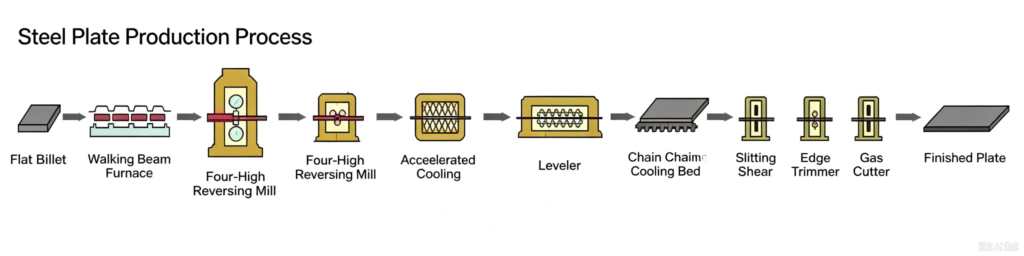
1. Steel plate production process flow
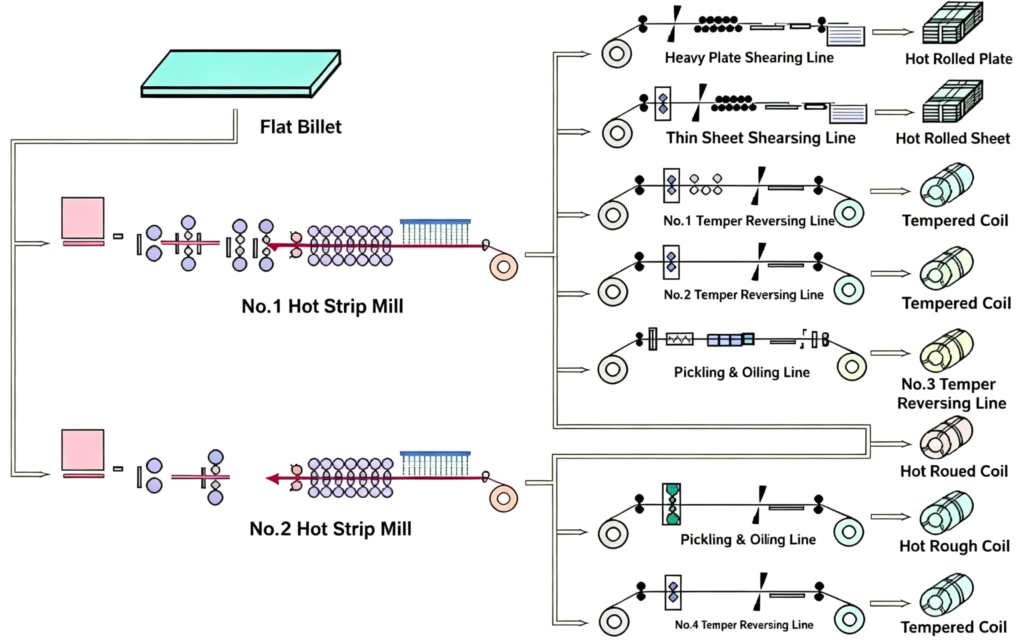
Steel plate production process: Steel plate production utilizes flat steel slabs as raw material. These slabs are heated to 1,200°C in a furnace and subsequently undergo rolling, cooling, and leveling before being cut (via mechanical shearing or flame cutting) into the finished product.