

As one of the important austenitic stainless steels, فولاد ضد زنگ ۳۱۶ is known for its excellent corrosion resistance and strength.
فولاد ضد زنگ ۳۱۶ is a molybdenum-containing austenitic stainless steel that maintains a face-centred cubic (γ) austenite at room temperature and has good plasticity and toughness. With good rust (corrosion) resistance, فولاد ضد زنگ ۳۱۶ can withstand high concentrations of chlorides and corrosive media, especially suitable for coastal and chemical environments.
فولاد ضد زنگ ۳۱۶ surface will form a thin layer of chromium oxide protective film, which can block oxygen and moisture contact with the iron element, preventing rusting.But it does not mean that it will not rust, it may still rust under certain conditions.
What is 316 Stainless Steel?
فولاد ضد زنگ ۳۱۶ has good rust-proof (corrosion resistance) properties, containing about 16 % Cr, 10 % Ni, and 2 % Mo. Cr can form a dense passivated oxide film on the surface,preventing further oxidation, and the addition of molybdenum further enhances resistance to pitting and crevice corrosion. فولاد ضد زنگ ۳۱۶ has good forming and processing performance, excellent corrosion resistance, and is widely used in applications with strict requirements for hygiene and corrosion resistance. In addition, 316L is the low carbon version, with a maximum carbon content of no more than 0.03%, is more resistant to intergranular corrosion, applicable to the application of corrosion resistance is still required after welding.
Difference Between 304 and 316 Stainless Steel
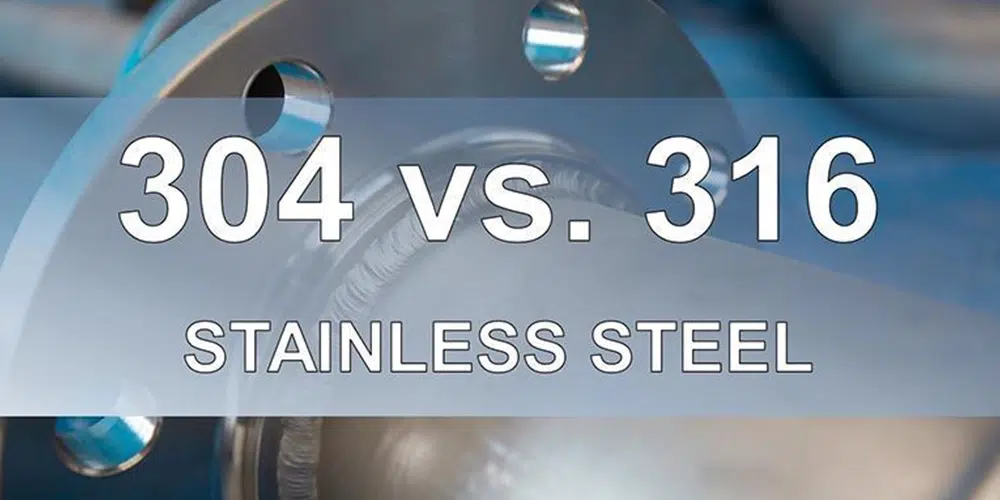
Although فولاد ضد زنگ ۳۱۶ and استیل ضد زنگ ۳۰۴ belong to the 300 series, there are significant differences in performance.
Chemical Composition
316 contains more nickel (Ni) and additional molybdenum (Mo) content, while 304 consists mainly of about 18% chromium and 8% nickel. 316 contains about 2% molybdenum, offering better corrosion resistance than 304 in chlorides and salt environments.
Corrosion Resistance
- 304 has good corrosion resistance, but is prone to crevice corrosion and pitting corrosion in marine, chemical and other salt-containing environments;
- 316 has great resistance to industrial solvents, seawater and salt spray, etc., due to the role of molybdenum,is the preferred material for chemical and marine applications.
High Temperature Resistance
316 is highly temperature resistance than 304, and can remain stable at higher temperatures.
Cost
استیل ضد زنگ ۳۰۴ is more economical than 316, as the latter contains molybdenum at a higher cost; however, in applications requiring high reliability, the higher initial investment of 316 usually results in lower maintenance costs.
Can 316 Stainless Steel Rust? Causes of Rust
Although فولاد ضد زنگ ۳۱۶ has excellent corrosion resistance, it is not absolutely rust-free. In normal conditions of use, 316 is less prone to rusting, due to the constant regeneration of the passivation film formed by chromium and molybdenum. However, in extreme or persistent corrosive environments, 316 can also be subject to localized rusting.
Common factors that cause 316 to rust include:
High Chloride Environments
Exposed to seawater, salt spray, or chloride-containing liquids for the long term can challenge the passive film. Even فولاد ضد زنگ ۳۱۶ may develop pitting or crevice corrosion, requiring regular cleaning and maintenance.
High Temperature Environments
When temperatures exceed 425°C (832°F), فولاد ضد زنگ ۳۱۶ may undergo sensitization, leading to intergranular corrosion.
Acidic or Alkaline Environments
Strong acids like hydrochloric acid can attack the passive film, causing uniform corrosion.
Contaminant Corrosion
Industrial fumes, acid rain, or construction dust adhering to stainless steel surfaces may cause rust spots if not promptly removed. Minor scratches on 316 surfaces may also trigger localised corrosion, if left with iron filings or cleaning agent residues.
Prolonged Lack of Maintenance
Regardless of the type of stainless steel, if it is not cleaned regularly and dirt accumulates, environmental factors may breach the protection of the passivation film, resulting in pitting corrosion on the surface.
Why Choose 316 Stainless Steel?-Advantages
The main advantages of فولاد ضد زنگ ۳۱۶ lie in its exceptional corrosion resistance and versatility.
Superior Corrosion Resistance
316 contains a higher molybdenum content, forming a more stable passive passivation layer, to maintain high corrosion resistance even in high-temperature or high-chloride environments. Compared to standard 304, 316 offers enhanced resistance to seawater, salt spray, and various chemical solvents.
High Temperature Strength
316 offers excellent high-temperature oxidation resistance and high tensile strength, enabling long-term use even below 800°C. With great work-hardening properties and formability, it can meet diverse machining and welding requirements.
Suitability for Harsh Environments
فولاد ضد زنگ ۳۱۶ performs well in complex conditions involving high corrosion, elevated temperatures, and chlorine-containing environments, ensuring long-term reliable equipment operation. It also forms a self-repairing passivation layer; the passive film can regenerate on its own, even if the surface is accidentally scratched or treated with cleaning agents.
How to Prevent Rust
Regular Cleaning
Remove salt, sulfate, and other deposits to prevent localized concentration increases.
Surface Passivation
Perform passivation after acid pickling (using 30% HNO₃ or a nitric/sulfuric acid mixture) to form a Cr-Mo-enriched passivation layer.
Post-weld Heat Treatment
Conduct solution annealing above 650°C followed by passivation to restore uniform distribution of Cr and Mo.
Conclusion
فولاد ضد زنگ ۳۱۶ offers excellent corrosion resistance, but it is not completely rust-proof. Under specific conditions—such as exposure to corrosive environments, improper maintenance, or physical damage—316 stainless steel may rust. Therefore, while فولاد ضد زنگ ۳۱۶ offers excellent corrosion resistance, it is not entirely immune to rust.
 English
  Русский
  Deutsch
  Español
  简体中文
简体中文  Português
  Italiano
  日本語
日本語  Bahasa Indonesia
  한국어
한국어  Français
  Nederlands
  العربية
  Tiếng Việt
  ไทย
ไทย  Tagalog
  Bahasa Melayu
  Polski
  Türkçe
  Português do Brasil
  हिन्दी
  Қазақ тілі
  বাংলা
বাংলা  Hausa
Hausa  Kiswahili
  አማርኛ
አማርኛ  فارسی
فارسی  Ελληνικά
  Română
  Українська