
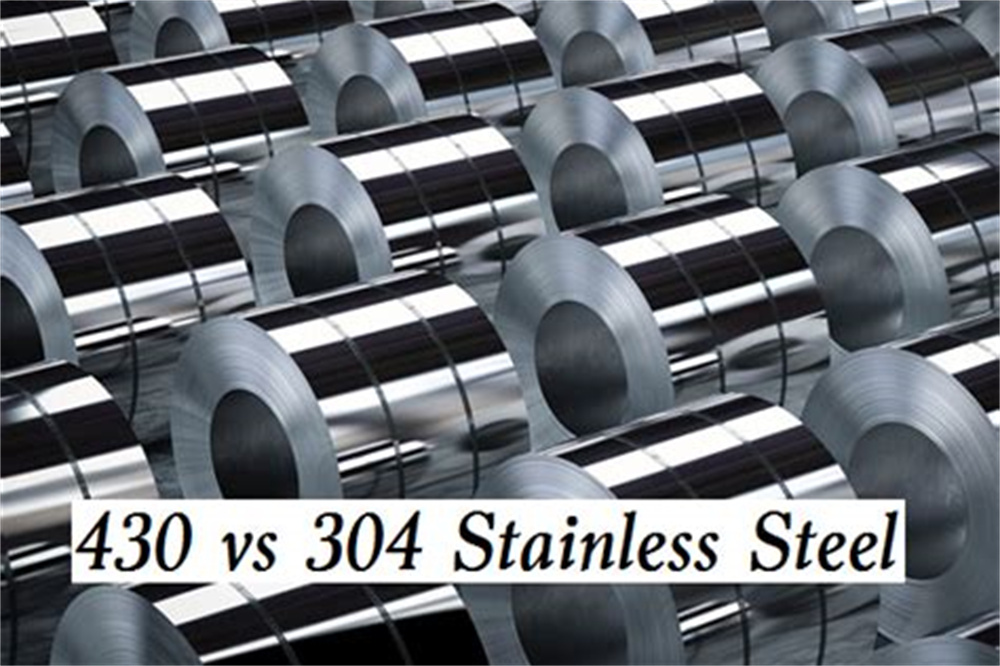
Stainless steels 430 and 304 are commonly used grades. Grade 304 offers better corrosion resistance and higher heat resistance, making it suitable for kitchenware and tableware; while grade 430 is relatively inexpensive and has high hardness, so it is often used for kitchen knives and decorative items. In this blog, let’s discuss the essential difference between 430 stainless steel and استیل ضد زنگ ۳۰۴.
400 series ferritic stainless steel, it derives its corrosion resistance primarily from 16–18% chromium and contains almost no nickel. It is magnetic, has good thermal conductivity, and is easy to form and machine, making it suitable for low- to mid-range indoor or mild environments.
Belongs to the 300 series of austenitic stainless steels (commonly known as 18/8 stainless steel), containing 18–20% chromium and 8–10.5% nickel, non-magnetic (or weakly magnetic), offers excellent overall performance, making it the most widely used stainless steel grade worldwide.
تفاوت بین فولاد ضد زنگ ۴۳۰ و فولاد ضد زنگ ۳۰۴
1.Fundamental Difference: Chemical Composition
استیل ضد زنگ ۳۰۴ contains nickel, while 430 contains none—this is the fundamental reason for their differences in performance.
- Grade 304: 18% Chromium + 8% Nickel. The nickel creates a stable, ductile “Austenitic” structure.
- Grade 430: 16-18% Chromium + 0% Nickel. This is a “Ferritic” steel, which is inherently magnetic.
| Feature | 304 Stainless Steel | 430 Stainless Steel |
|---|---|---|
| Chemical Composition | 18% Cr + 8% Ni | 16-18% Cr + 0% Ni |
| Corrosion Resistance | High (Salt/Acid resistant) | Moderate (Dry environment) |
| مغناطیسی | No (Non-magnetic) | Yes (Magnetic) |
| Cost | Higher (Nickel dependent) | Lower (Stable & Economy) |
| Best For | High-temperature Environments, Food, Medical | Appliances, Automotive, Trim |
2. Corrosion Resistance
The 8% nickel in 304 provides superior resistance to corrosion and oxidation.
Grade 304 offers superior corrosion resistance, performs well in environments exposed to moisture, mild acids, or salt spray and is suitable for outdoor furniture, food processing lines, and surgical tools.
430 stainless steel is highly resistant to oxidation in dry, indoor environments (like your kitchen). However, it is susceptible to pitting in coastal or high-humidity regions. If your product stays indoors and dry, 430 is a perfectly reliable choice.
Notice:
A simple way to distinguish between 430 and استیل ضد زنگ ۳۰۴ is to use a magnet. Grade 430 is strongly attracted to magnets. Grade 304 is non-magnetic in its annealed state (though it may become slightly magnetic after heavy cold-working).
3. Cost
- 430 stainless steel: Lower in price and cost-effective
- استیل ضد زنگ ۳۰۴: Higher in price (due to its nickel content)
Because nickel is an expensive, volatile commodity on the London Metal Exchange (LME), the price of 304 fluctuates wildly. Grade 430 is a “nickel-free” grade, making its price significantly lower and more stable.
In many industrial applications, switching from 304 to 430 can reduce material costs by 30% to 50%.
4. Workability
4.1 Weldability:
- 304: Easy to weld
- 430: Difficult to weld; requires preheating and annealing; prone to cracking
4.2 Fabrication:
- 304: Better formability
- 430: General formability
5. Application
Choose 304 For:
- Food & Beverage: Storage tanks, brewery equipment, milk processing.
- Medical: Surgical instruments, sterilization trays.
- Architecture: Coastal handrails, exterior cladding, roofing.
- Chemical: Pressure vessels and piping for corrosive chemicals.
Choose 430 For:
- Home Appliances: Refrigerator panels, dishwasher liners, washing machine drums.
- Automotive: Exhaust system components, decorative trim strips.
- Interior Design: Elevator panels, kickplates, indoor furniture accents.
- Housewares: Budget cutlery, sink bowls (indoor).
How to Choose 430 Stainless Steel and 304 Stainless Steel
Choose 430: For applications with limited budgets, interior decoration, low requirements for corrosion resistance, and good thermal conductivity.
Choose 304: For food-contact equipment, outdoor or humid environments, high requirements for corrosion resistance and long-term durability for key components.
 English
  Русский
  Deutsch
  Español
  简体中文
简体中文  Português
  Italiano
  日本語
日本語  Bahasa Indonesia
  한국어
한국어  Français
  Nederlands
  العربية
  Tiếng Việt
  ไทย
ไทย  Tagalog
  Bahasa Melayu
  Polski
  Türkçe
  Português do Brasil
  हिन्दी
  Қазақ тілі
  বাংলা
বাংলা  Hausa
Hausa  Kiswahili
  አማርኛ
አማርኛ  فارسی
فارسی  Ελληνικά
  Română
  Українська