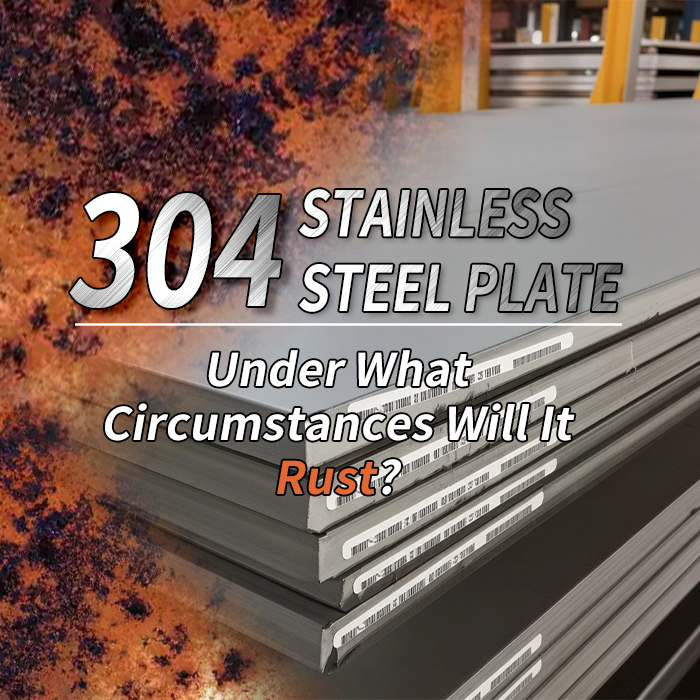
304 stainless steel is the most widely used and representative stainless steel grade. With its excellent corrosion resistance, formability and weldability, and relatively economical cost, it is widely used in industries such as manufacturing, construction, healthcare, and consumer goods. As a “general-purpose” material, 304 stainless steel is prone to exposing inherent limitations when subjected to specific harsh environments or special operating conditions.In chlorine-containing atmospheres, coastal settings, or high-temperature applications, 304 may fail faster than expected, leading to rework, downtime, and costly replacements.
304 stainless steel is an austenitic stainless steel composed of 18-20% chromium and 8-10.5% nickel,forms a passive chromium oxide layer on the surface that blocks oxygen and moisture, preventing rust. However, this passive layer is not flawless. The primary disadvantages of 304 stainless steel in practical applications are concentrated in the following areas:
1. Susceptibility to corrosion in specific chemical environments (particularly chloride-containing conditions), especially catastrophic stress corrosion cracking (SCC);
2. Limited capabilities in high-temperature environments, including risks of intergranular corrosion triggered by sensitization, insufficient creep strength, and degradation of mechanical properties.
Disadvantages of 304 Stainless Steel
1. Pitting and Crevice Corrosion Risk in Chloride Environments
In chloride-containing environments (seawater, salt spray, de-icing/de-icing solutions), high chloride ion concentrations can compromise passive films, leading to pitting and crevice corrosion.
304 contains no molybdenum (Mo) and is significantly less resistant to chloride-induced pitting and crevice corrosion than molybdenum-containing alloys (as grade 316/316L).
For applications involving prolonged exposure to seawater, salt-based cleaning agents, or road deicing salts, 304 is not recommended.
Preferred alternative materials: 316/316L, duplex/super austenitic stainless steel, or surfaces with specialized protective coatings.
2. Chloride-induced Stress Corrosion Cracking, Cl-SCC
This phenomenon occurs when 304 material is subjected to tensile stress (whether externally applied loads or internal residual stresses) while exposed to specific corrosive media (primarily chloride-containing liquid environments), leading to the initiation and propagation of cracks on the material surface.
Under tensile stress and in chloride-ion media, 304 stainless steel is susceptible to stress corrosion cracking (particularly sensitive at operating temperatures between 50–150°C).
Mitigation measures: Reduce residual stress (through proper stretching/tempering/stress relief annealing), design to prevent crevice accumulation, or select 316/low-sulfur/duplex materials.
3. High-temperature Welding causes Intergranular Corrosion
At temperatures exceeding 425°C, high-temperature welding causes carbon precipitation at grain boundaries to form carbides (sensitization), resulting in sensitization and intergranular corrosion.If low-carbon grades (304L) are not used or heat input is not controlled, corrosion resistance in the weld/heat-affected zone is degraded.
Solution: Use 304L (low-carbon) for welding projects, or perform subsequent annealing/passivation treatment.
4. High-temperature resistance is inferior to specialized heat-resistant steels
At elevated temperatures (long-term >800°C), 304 has a reduced resistance to oxidation, creep, and strength, with a higher risk of oxide layer spalling compared to heat-resistant grades as 310/316H/309.
Recommended alternatives: Use 310, 309, 321, or specialized heat-resistant alloys for high-temperature applications such as furnace tubes, heat treatment equipment, and combustion systems.
5. Wear and impact resistance are generally moderate (non-wear-resistant materials)
Austenitic stainless steels (e.g., 304) exhibit lower wear resistance and hardness compared to alloyed or surface-treated materials (e.g., hardened alloys, hard nickel plating, etc.).
Countermeasures: Select wear-resistant materials or surface coatings/linings for applications prone to abrasion.
How to minimize risks and resolve solutions
Learning about the disadvantages of 304 stainless steel helps engineers mitigate risks, while upgrading to more suitable materials like 316 or 310 can extend service life and reduce costs.
Material Selection Based on Operating Environment
- For exposure to seawater/salt spray/high chloride environments,316/316L or duplex stainless steel is preferred.
- For continuous operating temperatures exceeding 800°C,310/309 or heat-resistant alloys are more suitable.
- For applications requiring welding where annealing is not possible, 304L or 316L is recommended with post-weld passivation or controlled heat input.
FAQ
Does 304 stainless steel rust near the sea?
A: Long-term exposure to seawater or salt spray can cause pitting corrosion, leading to rust; 316 or duplex stainless steel is recommended.
For high-temperature applications, should we use 310 or 304?
A: 310 stainless steel is superior to 304 in high-temperature environments. Its higher chromium and nickel content provides better oxidation resistance and high-temperature strength.