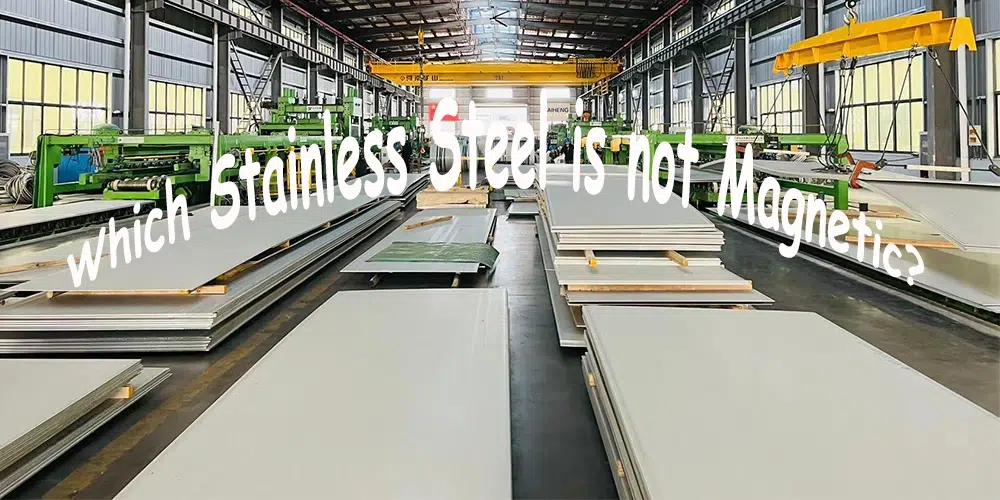
When testing a piece of stainless steel with a magnet, it sticks. While testing another piece, it doesn’t. Both are labeled “stainless steel.”
So which one is actually non-magnetic? Does it matter for the project?
In medical equipment, MRI-adjacent components, sensors, food processing, and precision instruments — using the wrong grade can cause equipment malfunction, regulatory failure, or outright product rejection.
In short, austenitic stainless steels — primarily grades 304, 316, 321, 310, and 904L, are non-magnetic in their annealed state. Ferritic and martensitic grades (409, 430, 410) are magnetic.
However, the changes after cold working will surprise most buyers.
Why Some Stainless Steels Are Magnetic and Others Aren't
Magnetism in steel is determined by its “crystal microstructure”, not simply its composition.
Stainless steel can be classified into five structural families:
| Family | Magnetic | Common Grades |
| Austenitic | Non-magnetic (annealed) | 304, 316, 321, 310, 347, 904L |
| Ferritic | Magnetic | 409, 430, 439 |
| Martensitic | Magnetic | 410, 420, 440C |
| Duplex | Weakly magnetic | 2205, 2507 |
| Precipitation-Hardened | Slightly magnetic | 17-4 PH |
The key is the “austenite phase”: a face-centered cubic (FCC) lattice structure that does not align with magnetic fields. Austenite is stabilized by nickel, which is why 300-series stainless steels (with 8–12% Ni) are the preferred non-magnetic choice.
Which Stainless Steel is not Magnetic?
Grade 304 – The Most Common Non-Magnetic Stainless Steel
- Composition: 18% Cr, 8% Ni
- Permeability (µr): 1.02–1.08 (effectively non-magnetic)
- Suit for: General fabrication, kitchenware, architectural components, chemical containers
Cold working (bending, drawing, rolling) can transform some austenite to martensite, introducing slight magnetism. Annealed 304 is reliably non-magnetic.
Grade 316 – Best Non-Magnetic Grade for Corrosive Environments
- Composition: 16% Cr, 10% Ni, 2% Mo
- Permeability (µr): 1.02–1.05 (more stable than 304 under cold work)
- Suit for: Marine, pharmaceutical, food processing, chemical piping
Why it’s preferred for EMI-sensitive applications: The added molybdenum and higher nickel content make the austenite more stable, reducing risk of magnetism after fabrication.
Grade 321 – Non-Magnetic with High-Temperature Stability
- Composition: 18% Cr, 9% Ni, stabilized with Titanium
- Suit for: High-temperature exhaust systems, heat exchangers, aerospace components
- Magnetic: Non-magnetic and stable up to 800–900°C
Grade 310/310S – Non-Magnetic at Extreme Temperatures
- Composition: 25% Cr, 20% Ni
- Suit for: Furnaces, kilns, heat treatment equipment
- Very high nickel content ensures robust austenite stability — remains non-magnetic even after heavy forming.
Grade 904L – Premium Non-Magnetic Austenitic Steel
- Composition: 20% Cr, 25% Ni, 4.5% Mo, Cu
- Suit for: Sulfuric acid environments, offshore, luxury watchmaking
Near-zero magnetic permeability even after cold work; used in luxury timepieces for its non-magnetic and corrosion-resistant properties.
Other Austenitic Grades That Are Non-Magnetic
- Grade 347
Niobium-stabilized; non-magnetic, good for welded structures;
- Grade 253MA
High-temperature, rare earth additions; non-magnetic
The Cold-Working: When Non-Magnetic Becomes Magnetic
304 stainless steel that has been cold-worked (pipe bending, swaging, deep drawing) can become measurably magnetic. This is because cold deformation converts austenite to martensite – a magnetic phase.
How to detect: Use a Feritscope or magnetic permeability gauge (not just a handheld magnet — too imprecise).
How to fix: Solution annealing (heating to 1050–1120°C and rapid quenching) restores the austenite phase and non-magnetic properties.
Note please: For critical non-magnetic applications, always specify: “solution annealed and water quenched” in order.
Magnetic vs Non-Magnetic Stainless Steels
| Grade | Magnetic | Typical µr | Common Use |
| 304 | Non-magnetic (annealed) | 1.02–1.08 | General use |
| 304 (cold-worked) | Slightly magnetic | Up to 1.5+ | Depends on forming |
| 316 | Non-magnetic | 1.02–1.05 | Marine/chemical |
| 321 | Non-magnetic | -1.02 | High temp |
| 310 | Non-magnetic | -1.01 | Extreme heat |
| 904L | Non-magnetic | -1.001 | Premium/precision |
| 430 | Magnetic | 400–600 | Automotive trim |
| 410 | Magnetic | 700–1200 | Cutlery, shafts |
| 409 | Magnetic | 200–400 | Exhaust systems |
| 2205 (Duplex) | Weakly magnetic | 5–10 | High-strength piping |
Which Non-Magnetic Grade Is Right for Your Application?
If you need non-magnetic stainless steel pipe or tube:
Choose 316L seamless tube (annealed) for most industrial uses; 304L for budget-sensitive projects.
For MRI rooms and medical imaging environments:
Use 316L or 304L, solution-annealed, with verified µr < 1.005. Require mill test certificates (MTC) and third-party permeability testing.
For offshore and subsea piping:
316L or 904L — both non-magnetic and highly resistant to chloride corrosion.
For food and beverage processing:
304 or 316 — both meet food contact standards and are reliably non-magnetic.
For precision instruments or sensors:
Choose 316L or 904L, cold-drawn and annealed. Avoid 304 if the part undergoes any cold forming.
For high-temperature furnace components:
310S or 321 — austenite stable under thermal cycling.
We supply austenitic stainless steel pipe and tube in grades 304, 304L, 316, 316L, 321, 310S, and 904L — all produced in solution-annealed condition with full mill test certificates.
- Material traceability from melt to delivery (EN 10204 3.1 / 3.2 MTCs)
- Magnetic permeability testing available on request
- Seamless and welded options, OD range 6mm–1200mm
- Export experience to 40+ countries
FAQ
Is 304 stainless steel magnetic?
Grade 304 stainless steel is non-magnetic in its annealed state. However, cold working (bending, drawing, stamping) can induce a slight magnetic response by converting austenite to martensite. For applications requiring guaranteed non-magnetic properties, specify solution-annealed 304 or upgrade to 316L.
Is 316 stainless steel magnetic?
No. Grade 316 is an austenitic stainless steel and is non-magnetic in its annealed state. It is more resistant to induced magnetism from cold work than 304 due to its higher nickel and molybdenum content.
How can I tell if stainless steel is magnetic?
A simple magnet test can detect strong magnetism (ferritic/martensitic grades). For precise measurement, use a Feritscope or permeability meter. Non-magnetic austenitic grades should have µr < 1.01.