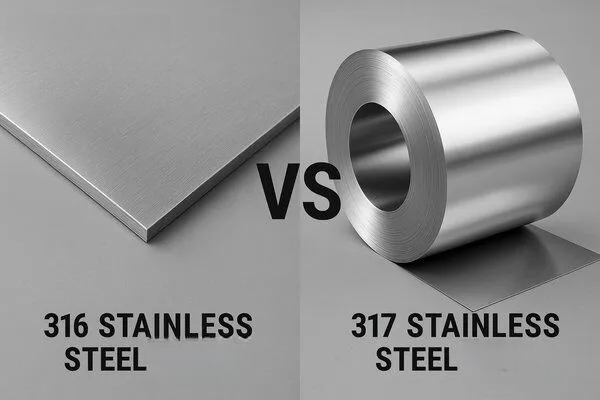
Both 316 and 317 stainless steel belong to the chromium-nickel-molybdenum austenitic stainless steel family and are indispensable corrosion-resistant materials in modern industry. The main characteristic of 317 stainless steel is its higher molybdenum (Mo) content (typically 3.0% to 4.0%), resulting in superior corrosion resistance compared to 316 stainless steel (typically containing 2.0% to 3.0% Mo), especially in resisting pitting corrosion, crevice corrosion, and corrosion in chloride-containing and other highly corrosive chemical environments. 317 stainless steel can be seen as a version of 316 stainless steel, suitable for more demanding and corrosive environments.
317 is a higher chromium, nickel and molybdenum version of 316 stainless designed principally for increased strength and corrosion resistance when compared to 316.
What is 317 Stainless Steel?
317 stainless steel belongs to the austenitic stainless steel series, containing 18–20% Cr, 11–15% Ni, and 3–4% Mo. Its high molybdenum content is a distinctive feature, enabling it to form a more stable passivation layer in chlorine-containing or strong acidic environments, thereby significantly inhibiting pitting and crevice corrosion.
The 317 alloy, containing 3–4% Mo, performs superior performance compared to the 316 alloy (containing only 2–3% Mo) in applications requiring enhanced resistance to pitting corrosion. In addition, the austenitic cubic crystal lattice structure provides 317 steel with good plasticity, toughness, and excellent low-temperature performance, making it suitable for various complex equipment and welded structures. Due to its high nickel content, grade 317 also has excellent weldability and high-temperature strength, meeting engineering requirements in harsh environments.
High-Temperature Performance
Stainless steel 317 offers excellent strength retention and oxidation resistance at elevated temperatures. Its higher alloy content, particularly molybdenum, provides superior high-temperature creep resistance, stress rupture resistance, and tensile strength compared to stainless steel 316.
Differences between 316 and 317 Stainless Steel
316 and 317 stainless steel are both austenitic stainless steels that have similar elements but differ in their composition and specific applications.
1. Composition:316 Vs. 317 Stainless Steel
| Element | 316 Stainless Steel | 317 Stainless Steel | Comparison |
|---|---|---|---|
| C | ≤0.08% | ≤0.08% | – |
| Mn | ≤2.00% | ≤2.00% | – |
| Si | ≤1.00% | ≤1.00% | – |
| Cr | 16.0–18.0% | 18.0–20.0% | The higher chromium content provides a more robust foundation for the passivation film in 317 stainless steel. |
| Ni | 10.0–14.0% | 11.0–15.0% | Higher nickel content enhances the stability of the austenitic microstructure and improves the corrosion resistance of 317 in specific environments, particularly its resistance to stress corrosion cracking. |
| Mo | 2.0–3.0% | 3.0–4.0% | This is the most critical difference. The higher molybdenum content gives 317 greater corrosion resistance. |
| S | ≤0.03% | ≤0.03% | – |
| P | ≤0.045% | ≤0.045% | – |
2. Corrosion Resistance: 317 steel is better
Corrosion resistance is the most critical factor distinguishing 316 and 317 stainless steel. 317 stainless steel offers superior corrosion performance to 316 stainless steel in nearly all aspects.
2.1 Pitting Corrosion and Crevice Corrosion
The pitting equivalent number (PREN) is a crucial indicator for measuring the pitting resistance of stainless steel. The higher the PREN value, the resistance of the material is greater to pitting and crevice corrosion.
The higher PREN value of 317 stainless steel exhibits superior resistance to pitting corrosion, crevice corrosion, and general corrosion compared to 316 stainless steel.
2.2 Resistance to General Corrosion
In terms of uniform corrosion, particularly in non-oxidizing or reducing acids, 317 stainless steel also performs better. The addition of molybdenum effectively enhances its tolerance in various acidic media such as sulfuric acid, phosphoric acid, formic acid, and acetic acid. Due to its higher molybdenum content, 317 exhibits better acid resistance than 316.
In boiling tests with 1% hydrochloric acid, the corrosion rate of 317 stainless steel is significantly lower than that of 316 stainless steel. This indicates that 317 offers a remarkable advantage when handling process fluids containing trace amounts of hydrochloric acid or other strong reducing acids.
3. Mechanical Properties
| Mechanical Property | 316 | 317 |
|---|---|---|
| Tensile Strength (MPa) | 515 | 515 |
| Yield Strength (MPa) | 205 | 205 |
| Elongation (%) | 40% | 40% |
| Hardness (HB) | ≤217 | ≤217 |
4. High-Temperature Resistance
Both 316 and 317 maintain strength up to:
- 870°C (intermittent use)
- 925°C (continuous use)
317 performs slightly better in carburizing environments.
5. Machinability
Both 316 and 317 exhibit excellent machinability. Due to its higher strength and potentially slightly greater tendency toward work hardening, 317 may be slightly more difficult to machine than 316 and may require higher cutting forces.
6. Application
316 stainless steel, with its excellent overall properties and relatively moderate cost, is widely used in:
- Food and Pharmaceutical Industries: Storage tanks, pipelines, valves, reactors, etc., leveraging its superior corrosion resistance and hygienic properties.
- Chemical Industry: For handling moderately corrosive chemicals.
- Marine environments: Employed in marine hardware and coastal structures, however, susceptibility to crevice corrosion in stagnant or low-flow seawater requires attention.
- Medical implants: Widely adopted due to its outstanding biocompatibility.
- Construction and decoration: Used as an alternative to 304 stainless steel in highly corrosive coastal or industrial areas.
317 stainless steel
With enhanced corrosion resistance,317 stainless steel is suitable for more demanding applications involving exposure to corrosive chemicals and acids. It is commonly used in chemical processing equipment, the pulp and paper industry, the textile industry, and in environments with high levels of chlorides and acids.
7. Cost
Due to its higher molybdenum and nickel content, the material cost of 317 stainless steel is significantly higher than that of 316 stainless steel. Therefore, 316 stainless steel is recommended for applications in relatively mildly corrosive environments.
How to Choose 316 and 317 Stainless Steel
When to choose 316 stainless steel:
- Your project requires good corrosion resistance, but the environment is not extremely harsh.
- Cost is the main consideration.
- Application scenarios are food processing, pharmaceuticals, construction, or standard marine environments.
When to choose 317 stainless steel:
- Your equipment will be exposed to high concentrations of chlorides, strong acids, or extremely corrosive chemicals.
- Performance and long-term reliability take precedence over initial cost.
- Application scenarios are flue gas desulfurization, highly corrosive chemicals, pulp manufacturing, etc.
JBLSTEEL-Your reliable 316 & 317 Stainless Steel Supplier
We JBLSTEEL supplies 316 and 317 stainless steel materials, whether it is bar, pipe, sheet or wire for braiding, it guarantees excellent processing performance.